
How to Sell a House with Tenants Living in It in Washington State
You may need to sell a rental before the lease ends, you may be tired of tenant problems, or you may simply want out of the Washington rental market. Fill out the form to see what your home could sell for as-is for cash or in a traditional sale.
- Cash offers in 24 hours or less
- We buy homes in as-is condition
- No inspections or contingencies
- No obligation or risk
- Close on your own timeline
- We’ll buy it with tenants in place

A renter signed a one-year lease in March. You decided to sell in September. A lot of owners who call me are surprised by this, since it’s the single biggest reason a Washington rental sale goes sideways at the closing table. It just runs on a different set of rules than selling the house you live in, and this guide walks through what those rules actually require of you.
Can You Sell a Rental Property with Tenants in Washington?
A paying renter with a clean payment history is an asset to the right buyer, and in Washington you can absolutely sell with tenants in place without ending anyone’s lease.
A tenancy isn’t terminated by the sale itself. Under Washington’s just-cause rules, a landlord can’t end a periodic tenancy except for listed causes, and a buyer who closes on an occupied property takes it subject to that tenancy. So the renter becomes the new owner’s renter. Same rent, same terms, same security deposit obligation, just a different name on the check.
Some are local families adding a second door; some run portfolios across Washington. They want rent rolls, deposit records, and a copy of every lease.
Not long ago I worked with two adult children in Puyallup whose mother had moved into assisted living. They’d been quietly covering her mortgage plus their own for close to a year, renting her place to a tenant whose rent didn’t come near the payment. The tenant had a car up on blocks in the garage and eight months left on his lease, and the family assumed they were stuck until it ran out. They weren’t.
This situation comes up a lot. Owners think a lease locks them in place when it really just defines who the buyer has to be. If you want to sell with tenants and keep the rent flowing until closing, your buyer pool narrows to people who want the income, and plenty of those buyers exist in Washington.
What Washington Laws Apply to Tenants When You Sell a Rental?
Guessing here carries that real cost.
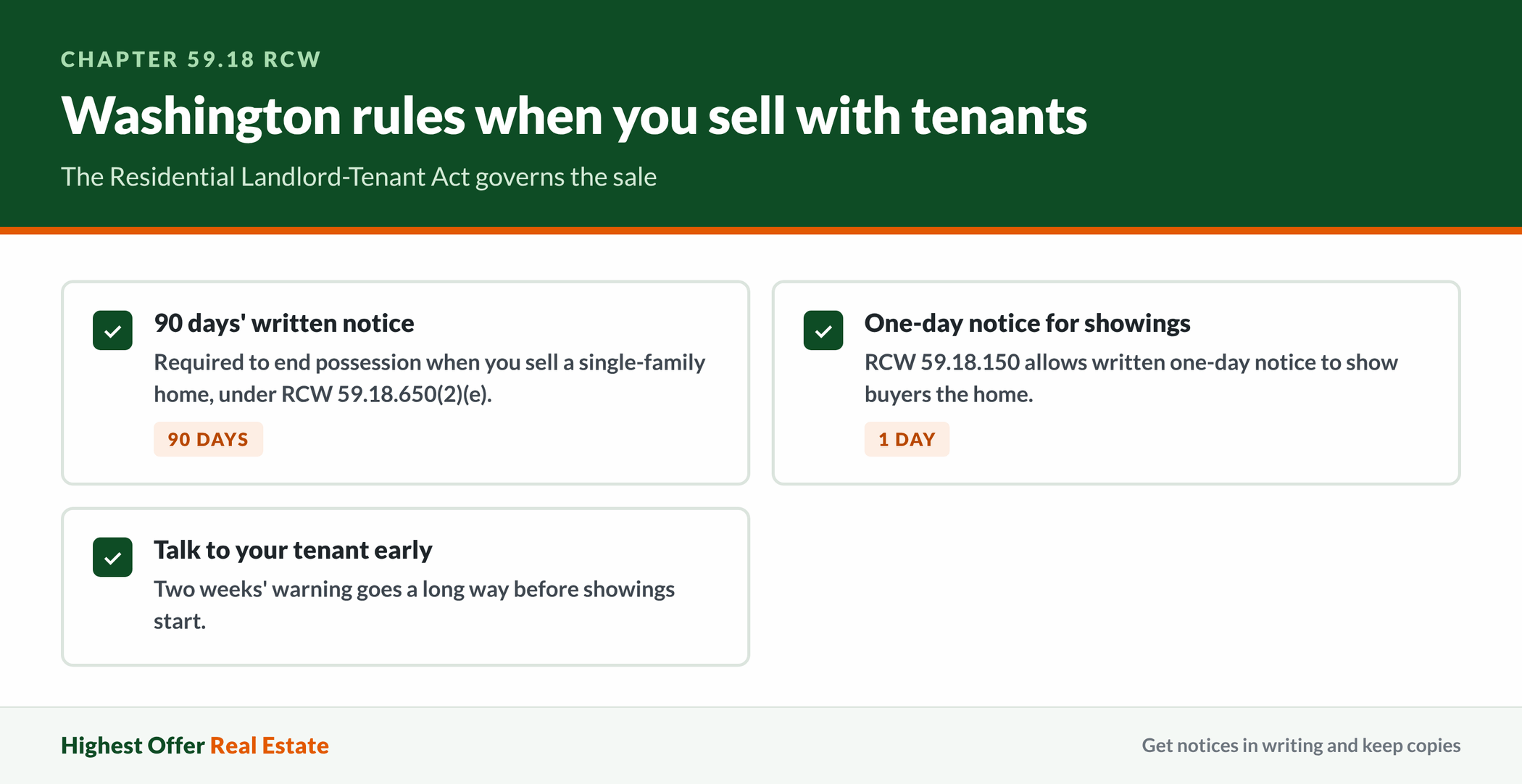
Washington’s Residential Landlord-Tenant Act, Chapter 59.18 RCW, governs everything about how you sell with tenants. Two provisions do most of the work. The first covers ending a tenancy because of a sale. When an owner elects to sell a single-family residence, Washington law under RCW 59.18.650(2)(e) requires at least 90 days’ advance written notice of the date the tenant’s possession is to end.
When you’re marketing a property for sale, RCW 59.18.150 allows a written one-day notice to show the home to prospective or actual purchasers. The notice has to be served properly, and entry has to happen at reasonable hours. General entry for other purposes carries a longer written notice requirement. My own practice is to give far more warning than the minimum, because a tenant who feels ambushed can make a Saturday open house miserable without breaking a single rule.
Deposits have their own statute. When landlord status transfers to someone else during a tenancy, the money in the deposit trust account transfers at the same time to an equivalent trust account held by the successor landlord. The successor landlord then has to promptly notify the tenant of the transfer and the name, address, and location of the new depository.
Fixed-term leases in Washington don’t bend to a sale at all. If your renter has eight months remaining, those eight months travel with the deed unless the tenant agrees otherwise in writing. I’ve seen sellers assume a closing wipes the lease clean, which it doesn’t. Some Washington cities layer additional protections on top of state law, so check with your city before you send any notice.
What Rights Do Owners Have to Sell with Tenants in Washington?
You can list it, market it, photograph the exterior, hire any brokerage in Washington you like, negotiate whatever price you want, and sign a purchase and sale agreement. You do not need to ask permission from anyone living there.
The right to show the interior comes with conditions. Washington tenants can’t unreasonably withhold consent to entry for showings once proper written notice has been served.
Owners also have the right to sell with tenants to a buyer who never sets foot inside. Cash buyers and investors in Washington routinely underwrite occupied properties off the lease, the rent roll, and exterior condition.
One more right people forget: you can offer your tenant money. Cash-for-keys isn’t a loophole, it’s a voluntary agreement, and it’s often cheaper than the alternative. A renter who leaves cooperatively on a date you both picked beats a hostile holdover by a wide margin, and I’ve seen that goodwill save landlords weeks of hassle. Put it in writing, have a Washington attorney glance at the document, and pay only at move-out.
You can also sell with tenants and simply let the lease ride. In Washington markets where rents are strong, it’s frequently the most profitable choice, because the buyer inherits income on day one and will pay for it.
What Are Your Legal Obligations When You Sell with Tenants?
“Do I have to tell my renter I’m selling?”
Yes, and sooner than owners want to. The lockbox and the sign will be seen by your tenant. Finding out from a stranger at the door poisons the relationship right when you need cooperation most, so skipping that conversation almost always backfires. Beyond common courtesy, the written notice requirements described above are not optional in Washington.
Your maintenance duties don’t pause during a sale. The tenant keeps paying rent, and the landlord keeps maintaining the property and respecting the tenant’s right to quiet enjoyment.
Dated notices, delivery method, photographs of posted notices. When owners sell with tenants and later face a dispute, the paper trail decides it.
At closing you owe the buyer accurate information: every lease, every addendum, the deposit ledger, rent payment history, and any pending repair requests. I ask for these on every occupied house I buy in Washington.
Prorating rent is the detail that trips up first-time sellers, and I’ve watched it stall a closing when nobody caught the math beforehand. If your renter pays on the first and you close on the eighteenth, the buyer is owed the remaining days. Your escrow officer handles the math, but you have to hand over the correct numbers. Underreport the deposit and that shortage comes out of your proceeds.
Can Tenants Stay After You Sell with Tenants in Washington?

One detail rarely makes it into articles on this subject: a buyer who wants to move into the house personally can’t simply inherit your tenancy and end it on their own timetable. Washington’s just-cause statute requires advance written notice within a few weeks when an owner or immediate family member intends to occupy the home as a principal residence. The occupant has to actually live there for at least 60 consecutive days or face a bad-faith presumption.
Fixed-term tenants stay through the end of the term.
Owner-occupant buyers using FHA or VA financing often need possession within sixty days of closing. So when you sell with tenants on a lease running past that window, those loan applications fall apart. Your buyer pool shifts toward investors and cash purchasers across Washington.
Does that cost you money? In the Puget Sound region, sometimes a little. In Pierce County, where investor demand for occupied rentals is steady, often not much at all.
Yes. Owners who want a vacant house at closing frequently serve the required notice first, then list once the date is locked in.
Investors buying in Washington right now are hunting for exactly that.
What Is Your Rental Worth Before You Sell with Tenants?
A duplex owner in Everett priced his occupied property off neighborhood comps and sat for weeks.
Valuation shifts when you sell with tenants, because two different buyer types measure the same building with different rulers.
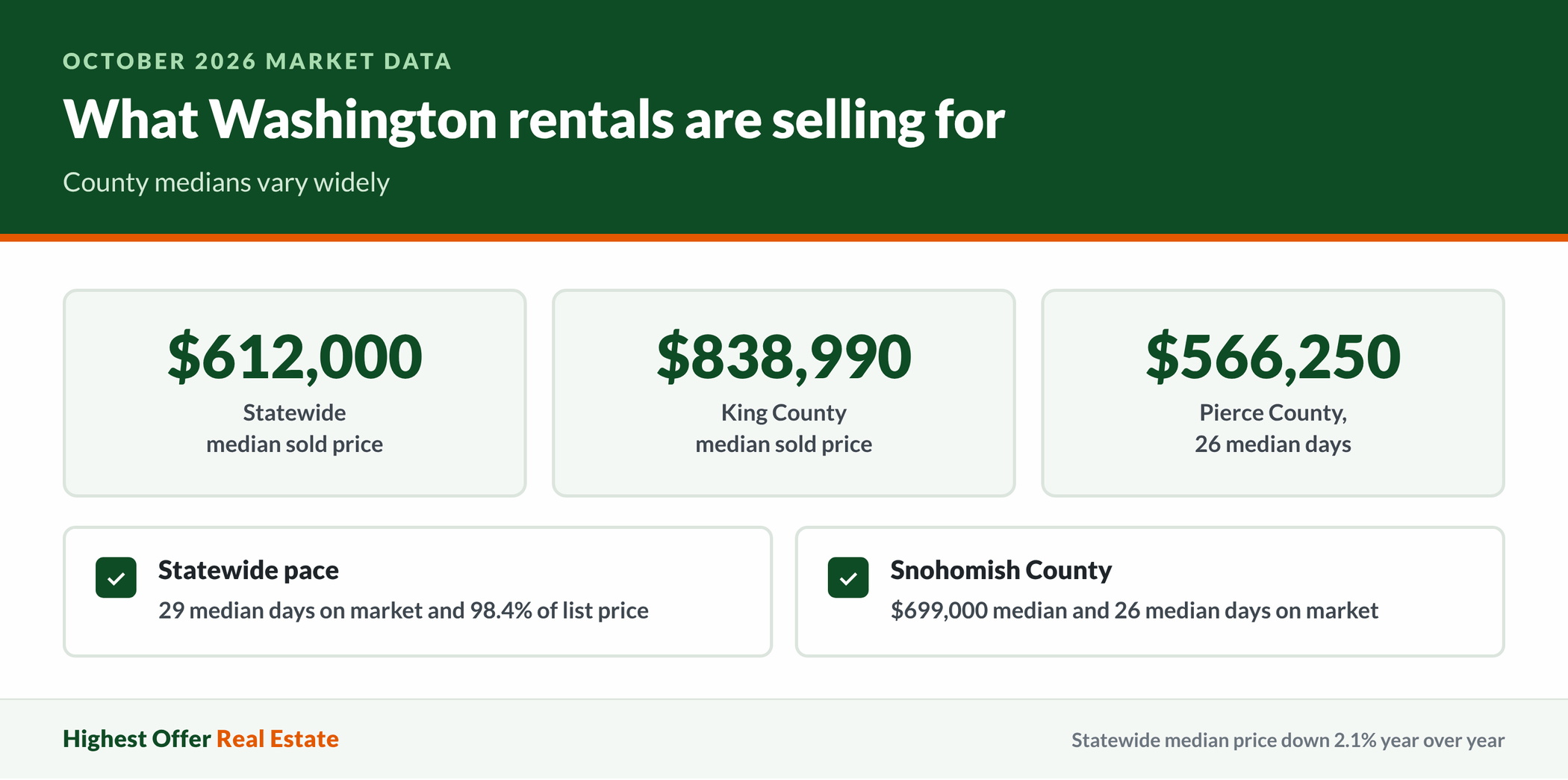
Washington’s market tells the real story. Statewide numbers as of early October 2026 showed a median of 29 days on market over the prior rolling period. Sellers received 98.4% of list price, four months of inventory, and the statewide median price down 2.1% year over year. King County carried a median sold price of $838,990 against a statewide median of $612,000 that same week. Those are balanced-market conditions, not a fire sale.
You should weigh county-level spread more than the statewide figure. Pierce County showed a $566,250 median sold price in October 2026 with 26 median days on market, while King County came in at $838,990.
Below-market rent is the quiet value killer. An investor capitalizing your income stream prices the lease you have, not the lease you could get. Once a cap rate gets applied, a unit renting three hundred dollars under market in Tacoma drags the valuation down by far more than that annually.
How Do You Sell a House with Tenants in Washington?
Listing an occupied rental on the open market with a lockbox and ten showings a week is usually the wrong move.
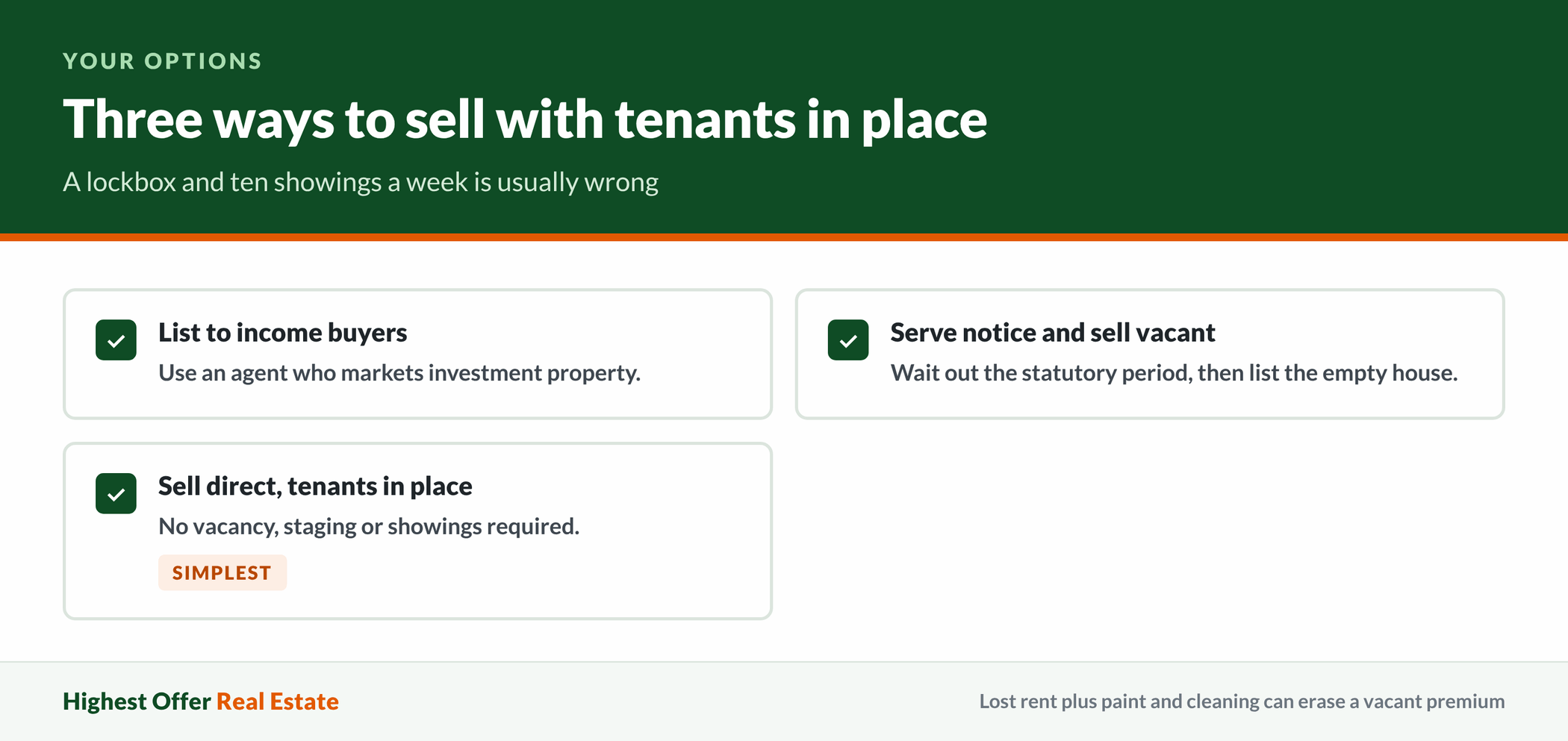
You’ve got three paths. You can list with a Washington real estate agent who specializes in investment property and market to buyers who want income. You can serve proper notice, wait out the statutory period, and sell vacant. Or you can sell with tenants directly to a cash buyer who underwrites occupied property as a matter of routine.
Three months of lost income plus paint, carpet, and a cleaning crew can erase whatever premium a vacant listing earns in a balanced Washington market.
Direct sale is the cleanest route when the tenancy is complicated or the relationship has soured. Companies like Highest Offer Real Estate buy occupied rentals across Washington without requiring vacancy, interior staging, or a parade of strangers through someone’s living room.
Whichever path you pick, talk to your tenant early and treat them like a partner. I’ve had renters clean a unit spotless before showings because I gave them two weeks’ warning and a gift card. Same house, different approach, very different outcome.
Buyers who regularly buy occupied property in Washington will ask for all of it in the first week.
What Taxes Do You Pay When You Sell a Rental with Tenants?
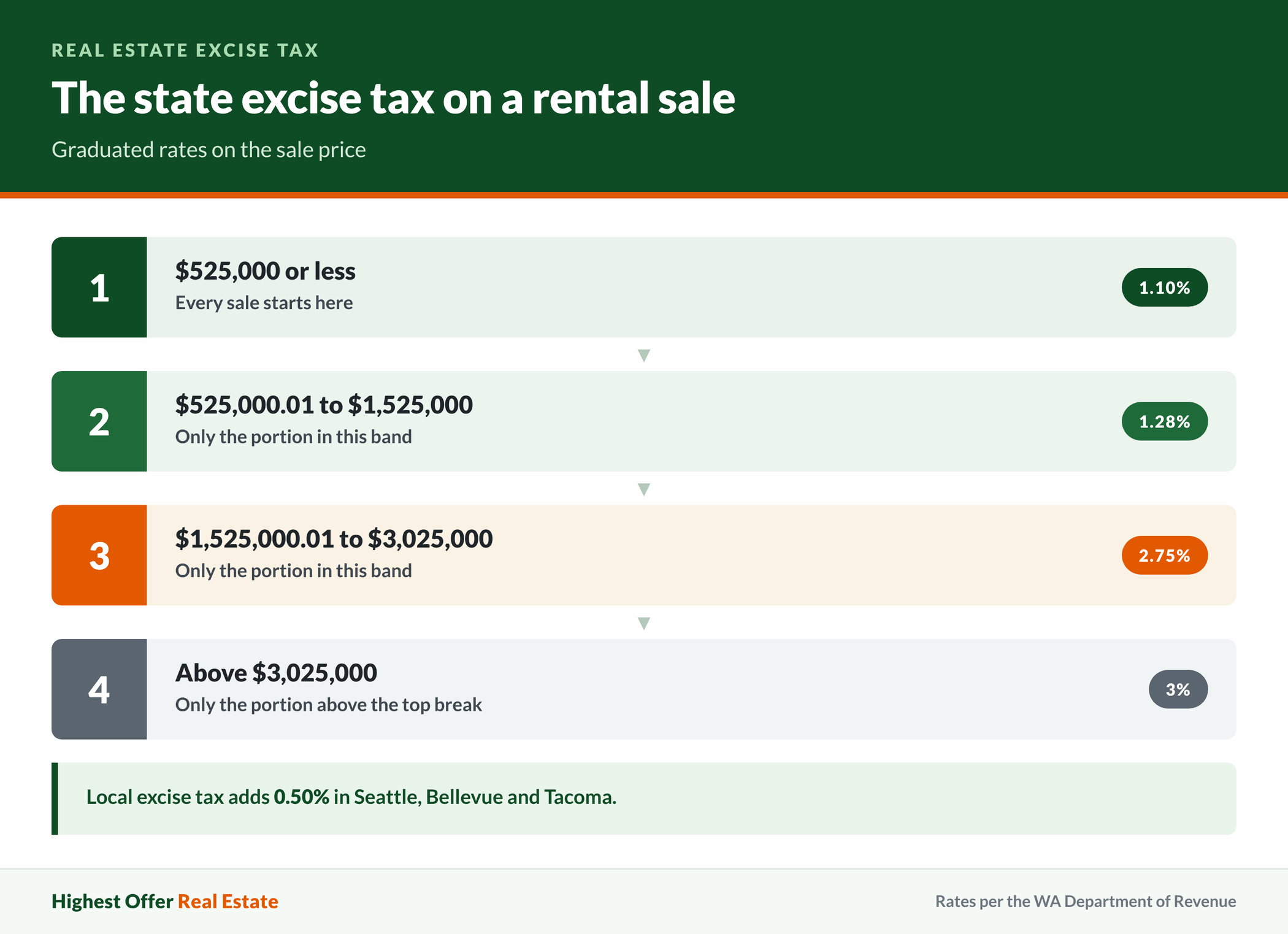
One point one percent. That’s where Washington’s real estate excise tax starts. The graduated state REET structure runs 1.10% on sale prices of $525,000 or less, 1.28% from $525,000.01 to $1,525,000, 2.75% from $1,525,000.01 to $3,025,000, and 3% above that. Current tables come from the Washington Department of Revenue. Local REET runs 0.50% in Seattle, Bellevue, and Tacoma according to the Department of Revenue’s May 2026 local rate table. Your city’s rate is on that same page.
Rentals don’t qualify for the homeowner capital gains exclusion unless you lived in the property as your primary residence under the IRS rules. The IRS’s guidance on selling your home spells out in detail.
Depreciation recapture is the line item sellers forget. Every year you claimed depreciation on that rental, you lowered your basis, and the IRS wants that back at sale. Owners who’ve held a Washington rental for fifteen years are often startled by the recapture figure their accountant produces.
A 1031 exchange defers both the gain and the recapture if you roll proceeds into another investment property. Occupied rentals make clean exchange candidates, since the income continues uninterrupted.
An heir in Lacey called me about a house she’d inherited with a long-term renter still in it. Her contractor quoted a kitchen remodel that exceeded what the kitchen itself added to the property. The quote didn’t even include the back deck. That is the kind of number that makes you rethink the whole project. She sold with tenants in place on a Thursday closing and never spent a dollar on cabinets.
Talk to a Washington CPA before you list. The tax outcome on a rental sale is usually more negotiable, and the moves that help have to happen before closing, not after.
Frequently Asked Questions
Do I Have to Give My Renter Notice Before I Sell with Tenants in Washington?
Yes. If you plan to end the tenancy because of the sale, Washington’s just-cause statute requires advance written notice covering the full period described earlier in this article. If you’re keeping the tenant in place and simply transferring ownership, no termination notice is needed, though you still owe separate written notice before any showing. Telling your tenant what’s happening early is also just good practice.
Can My Tenant Refuse to Let Buyers See the House?
Not unreasonably. Once you’ve served proper written notice stating the date and a reasonable time window, a Washington tenant can’t block access for a showing without a legitimate reason. Practically speaking, forcing the issue rarely helps, because a resentful renter can make a property look terrible without technically violating anything. Offering flexible scheduling or a small incentive works better than quoting statutes at someone.
What Happens to the Security Deposit When I Sell with Tenants?
It moves to the buyer at closing. Washington law requires the deposit funds to transfer into the new owner’s trust account at the same moment landlord status transfers. The new owner then has to tell the tenant where the money is now held. Your escrow officer handles this as a credit on the settlement statement. Hand over an accurate deposit ledger, because any shortfall comes out of your proceeds.
Will I Get Less Money If I Sell with Tenants Instead of Selling Vacant?
Sometimes, though less often than people fear. An occupied rental appeals to investors who value income, and in parts of Washington with strong rental demand, a performing lease can hold value as well as an empty house. Where you lose ground is when the rent sits well below market, since a buyer prices the lease you have. Compare the possible price difference against the rent you’d give up during a vacancy before deciding.
Can I Evict My Tenant Just So I Can Sell the Property?
Eviction and a sale-based termination are two different things in Washington. Eviction requires a tenant default, like unpaid rent or a lease violation, and runs through the courts. Ending a tenancy because you’re selling is a separate permitted cause with its own written notice requirement, and it isn’t available mid-lease on a fixed term unless the tenant agrees. If someone tells you to file an eviction simply to clear the house for sale, get a second opinion from a Washington attorney.
Who Buys Tenant-occupied Rental Properties in Washington?
Investors, small landlords building a portfolio, and direct cash buyers who buy occupied property regularly. Traditional owner-occupant buyers usually can’t make it work, since their financing and move-in timelines collide with an existing lease. If you want to sell with tenants without the showings and the uncertainty, a buyer who already owns rentals in Washington is your most likely match.
How Long Does It Take to Sell with Tenants in Washington?
A direct sale to a cash buyer can close in a couple of weeks, since there’s no appraisal contingency and no loan underwriting. A traditional listing takes longer, and you’re adding showing coordination on top of the typical market timeline described above. If you need the house vacant at closing, add the full statutory notice period to whatever your sale timeline looks like, and start that clock early.
Do I Need an Attorney to Sell with Tenants?
Not legally, but I’d recommend one for anything unusual. A Washington real estate attorney is worth the few hundred dollars if your tenant has a long fixed-term lease or an unpaid rent history. The same goes if you’re drafting a cash-for-keys agreement, or if your city layers extra rules on top of state law. For a straightforward transfer with a cooperative renter, a good escrow officer and an experienced buyer usually cover it.
Maybe you own a rental somewhere in Washington and can’t decide whether to wait out the lease, serve notice, or just sell with tenants in place. I’m happy to talk it through. We buy occupied properties all over the state and can tell you honestly whether a direct sale makes sense for your situation or whether you’d do better listing. Reach out through Highest Offer Real Estate whenever you’re ready. No pressure, no obligation, and no hard feelings if you decide to go another direction.
Selling a Rental With Tenants in Tacoma and Pierce County
Tacoma landlords work under the same state notice rules as everyone else in Washington. A tenant who stays put doesn’t stop a sale here.
Pierce County rentals with tenants in place often sell fastest to buyers who want the income.
Get an Offer on Your Occupied Rental
Contact Highest Offer Real Estate and we’ll make an offer with your tenants still in place.
You can also fill out the short form below. There’s no cost and no obligation.