

Three hundred bankers boxes, stacked floor to ceiling. One family found that inside a split-level outside Puyallup, and nobody in the family had opened the front door in eleven months. If you’re facing a hoarder house in Washington right now, you already know that kind of paralysis. Honestly, the house isn’t the hard part.
I’ve bought houses across this state for years. The cluttered ones are the properties people apologize for before I’ve even reached the porch, and you deserve a plan instead of an apology.
What Is a Hoarder House and How Do You Sell One in Washington?
Messy isn’t the same as a real problem, and the line matters.
Most lenders and inspectors use a rough test. If stored belongings block exits, hide the mechanical systems, or pile high enough that an appraiser can’t assess the structure, you’ve got a hoarder house.
Selling one in Washington follows the same legal track as any other sale, with two wrinkles. You still owe the buyer a Seller Disclosure Statement. The condition also shrinks your buyer pool to cash and renovation lenders.
Washington’s disclosure rules sit in Chapter 64.06 RCW, and brokers call the document Form 17. The seller delivers the completed statement within five business days of mutual acceptance unless both sides agree otherwise in writing. Once the buyer has it, they get three business days to approve the statement or rescind the purchase agreement entirely, at their sole discretion.
A buyer who learns about the rodents on day two of that rescission window walks away. A buyer who knew before writing the offer usually stays.
Selling one in Washington isn’t really a legal problem. It’s a logistics problem wearing a legal costume.
Why Do Washington Homeowners End Up with a Hoarder House?
In 2009, a retired machinist in Everett picked up one extra chest freezer because the sale was too good to pass up. By 2024 his daughter counted six. Four weren’t plugged in, and the path through his dining room had shrunk to eighteen inches.
Nobody plans for this. In a cluttered Washington home, the piling up almost always starts with a loss: a spouse dying, a job ending, a hard diagnosis. Shame comes next, and once the invitations stop, nobody who could help sees the inside of the house.
The weather doesn’t help. Western Washington stays damp, so stacked cardboard turns into a mold farm faster than you’d think. Block the vents in a Washington house and mildew can show up behind the drywall within a couple of winters.
Age matters too. Lots of Washington hoarder situations come to light when an aging parent can’t manage the stairs anymore and a son or daughter walks into the home for the first time in years.
Then the pests arrive. Mice and carpenter ants love that shelter during a wet Washington fall, and the odd raccoon moves in under the crawlspace hatch.
A few years back I bought a rambler in Lakewood from three adult siblings who’d listed it twice with agents. We closed in nineteen days, and they never had to haul a single box.
What Is My Hoarder House Worth in Washington?
For a long time I valued these properties by subtracting cleanup costs from market value. That math was wrong.
The real discount comes from the unknowns underneath, like a subfloor nobody’s seen in a decade or plumbing that may have frozen. Often the roof stopped getting attention the same year the clutter started. A cash buyer prices that uncertainty, not the junk.
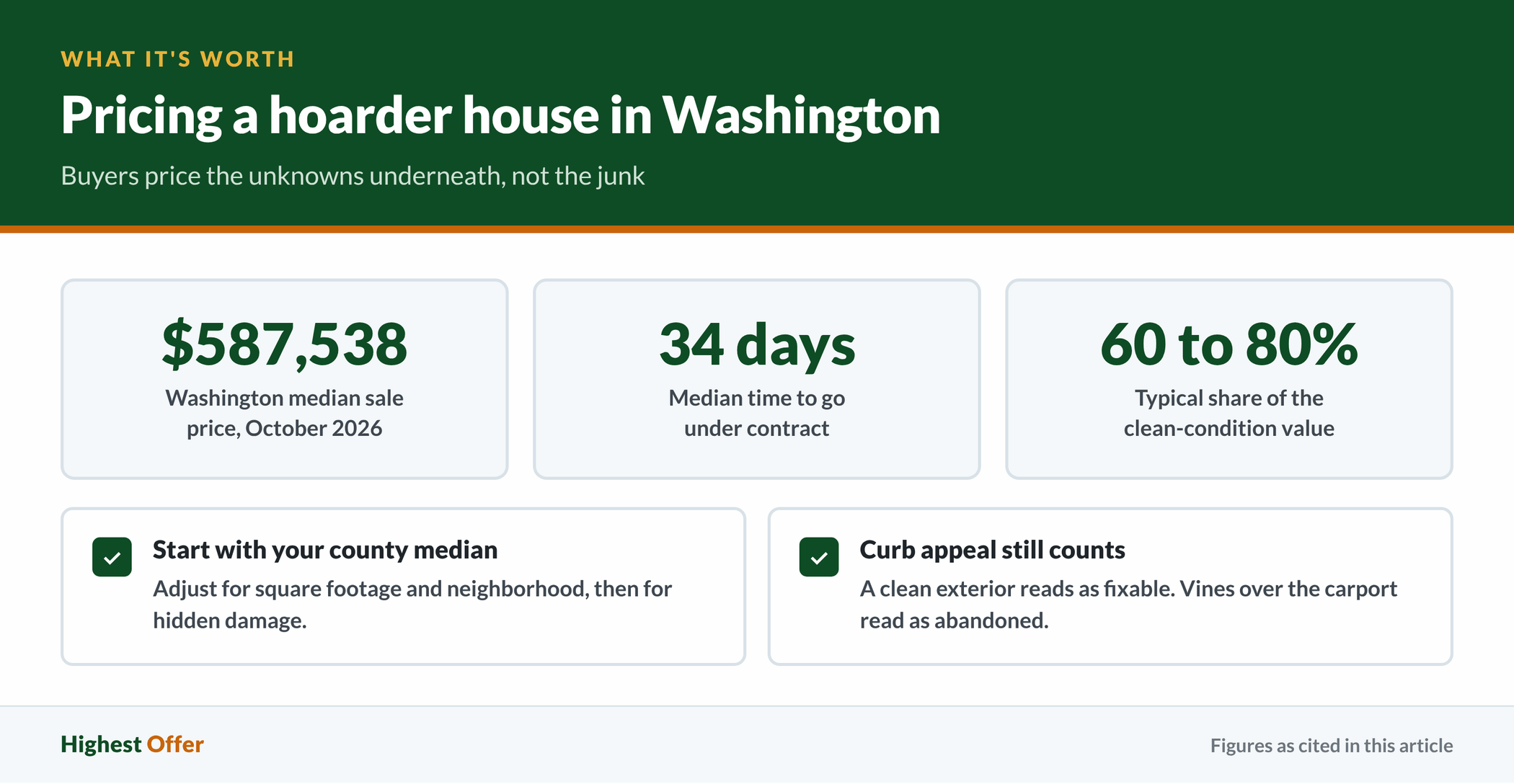
Redfin put Washington’s median sale price at $587,538 in October 2026, down 2.1% from a year earlier, with homes going under contract in a median of 34 days. County numbers swing a lot. Northwest MLS data from early October 2026 showed King County at a $838,990 median sold price. East of the mountains, Spokane County’s median sat near $435,000 that fall.
Start with your county median and adjust for square footage and neighborhood. In Washington, expect a hoarder house to sell for 60 to 80 percent of that clean-condition figure, depending on the structural damage under the contents.
Lot size and a newer roof pull the number up. So does a location like Ballard or downtown Bellingham, where the land carries the value regardless of condition.
Curb appeal matters more than you’d think. A clean exterior with a packed interior prices better than a house where blackberry vines have swallowed the carport. The first reads as fixable, and the second reads as abandoned. If you want a condition-based number without listing, Highest Offer Real Estate will walk a property like yours and put a figure on paper.
Can You Sell a Hoarder House in Washington Without Cleaning It First?
Leave it. All of it. I mean that.
I say that at kitchen tables all the time, and sellers rarely believe me the first time. You can absolutely sell one in Washington with every room exactly as it stands today. Plenty of the houses I’ve bought closed with the refrigerator still humming and full.
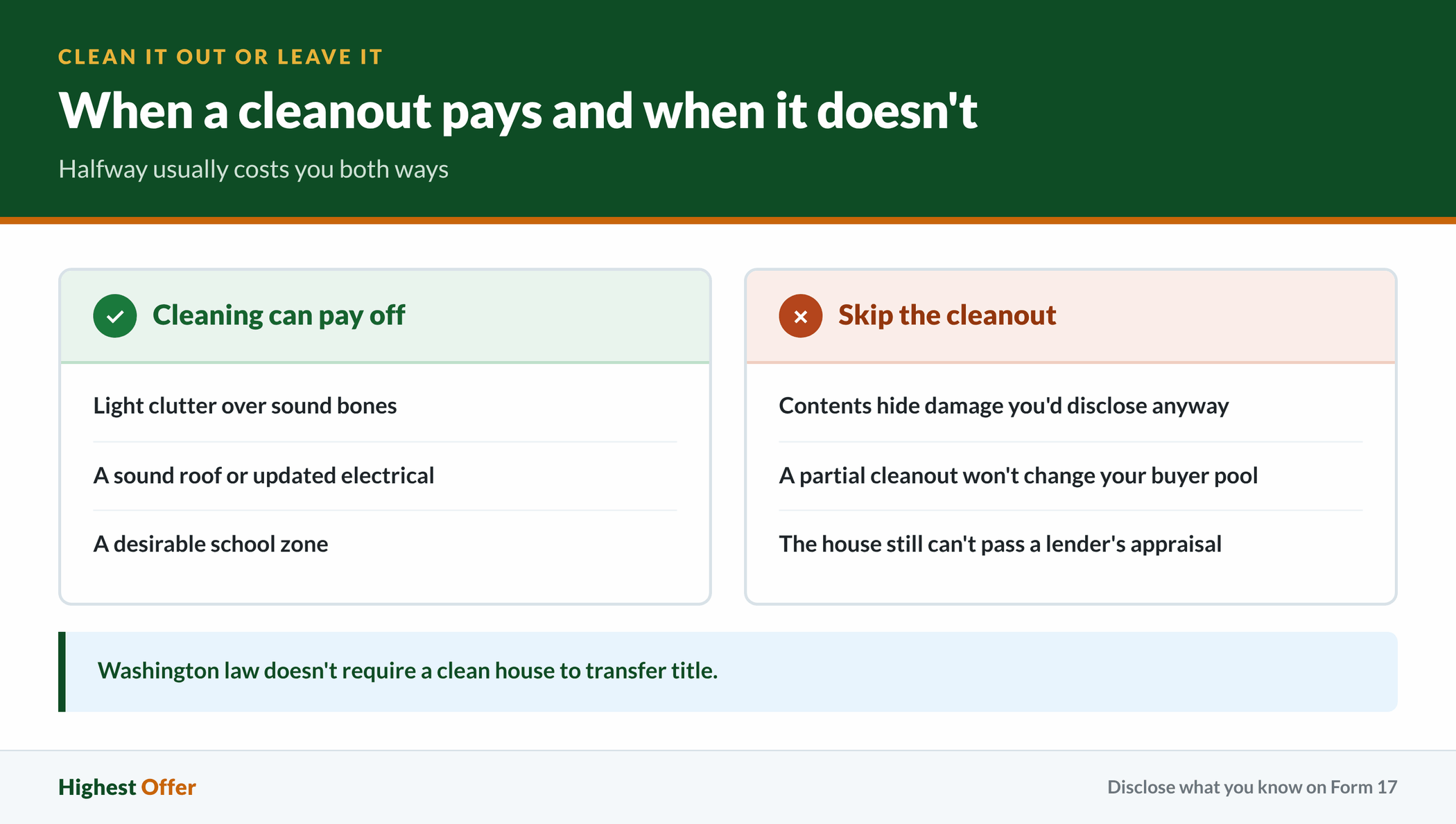
Washington law doesn’t require a clean house to transfer title. The disclosure obligation covers what you know about the property’s condition, and tidiness doesn’t enter into it. Sellers disclose known material facts, so the word that matters in that statute is known. If you’ve never been in the back bedroom, say so on the form instead of guessing.
Financing is the catch. A buyer using a conventional loan needs an appraiser who can reach the mechanical systems and verify the structure, and an appraiser who can’t get to the furnace will flag the file. FHA and VA appraisals are even stricter. That’s how a hoarder house in Washington ends up with an accepted offer that dies in week five.
No one pays retail for a property they can’t inspect.
I keep seeing the same pattern. Families spend eight weekends and real money on partial cleanouts, then still sell to a cash buyer at roughly the as-is number. Partial cleanup rarely changes which buyer pool you land in, because either the house reaches lendable condition or it doesn’t, and halfway costs you both ways.
Cleaning truly pays off in a Washington hoarder house in one narrow case: light clutter over sound bones.
Should You Hire a Junk Removal Crew Before Selling a Hoarder House?

People often ask me whether a cleanout crew will charge thousands to haul away their mother’s things.
A professional crew with biohazard certification can empty a three-bedroom Washington hoarder house in two or three days. They’ll handle sharps, animal waste, and spoiled food you shouldn’t touch without a respirator.
I’d spend that money in some cases and not others. Pay for removal when the house has value worth showing, like a sound roof, updated electrical, or a good school zone in Issaquah or Camas. Skip it when the contents hide damage you’d have to disclose and repair anyway.
Crews charge by volume and by the hour. Families can burn months arguing over what’s sentimental while taxes and insurance keep running.
My advice is a mild heresy. Take one weekend, grab the documents, photos, jewelry, and firearms, and let the rest go. I’ve found deeds, military records, and loose cash in strange places, so check freezers, coat pockets, and book spines first.
Washington transfer stations charge by the ton, and a hoarder house often runs several full loads. Call your county solid waste department for current tipping fees before you sign a flat-rate contract. That’s where I’ve seen estimates quietly inflate.
Email the crew a list of what stays and what goes, and keep that email. It settles disputes over a missing heirloom fast.
What Legal Issues Come Up When Selling a Hoarder House in Washington?
An heir in Yakima called me after inheriting a property she’d never set foot in, hoping to sell within the month. Probate hadn’t been opened, her brother’s name was still on the deed, and the city had already posted a nuisance notice about the yard.
Every hoarder house transaction starts with title. If the owner has died, somebody needs legal authority to sign, and in Washington that usually means a personal representative appointed through the superior court in the county where the person lived.
Disclosure is the second trap. It catches sellers who think “as-is” erases the duty, and it doesn’t. Washington’s statute protects a seller from liability for an error or omission only when the seller had no actual knowledge of it. Volunteering the mold, the rodents, and the roof leak protects you better than staying quiet.
Many Washington cities will cite a property for accumulated outdoor debris. Those citations can become liens against the title, and escrow has to clear them at closing.
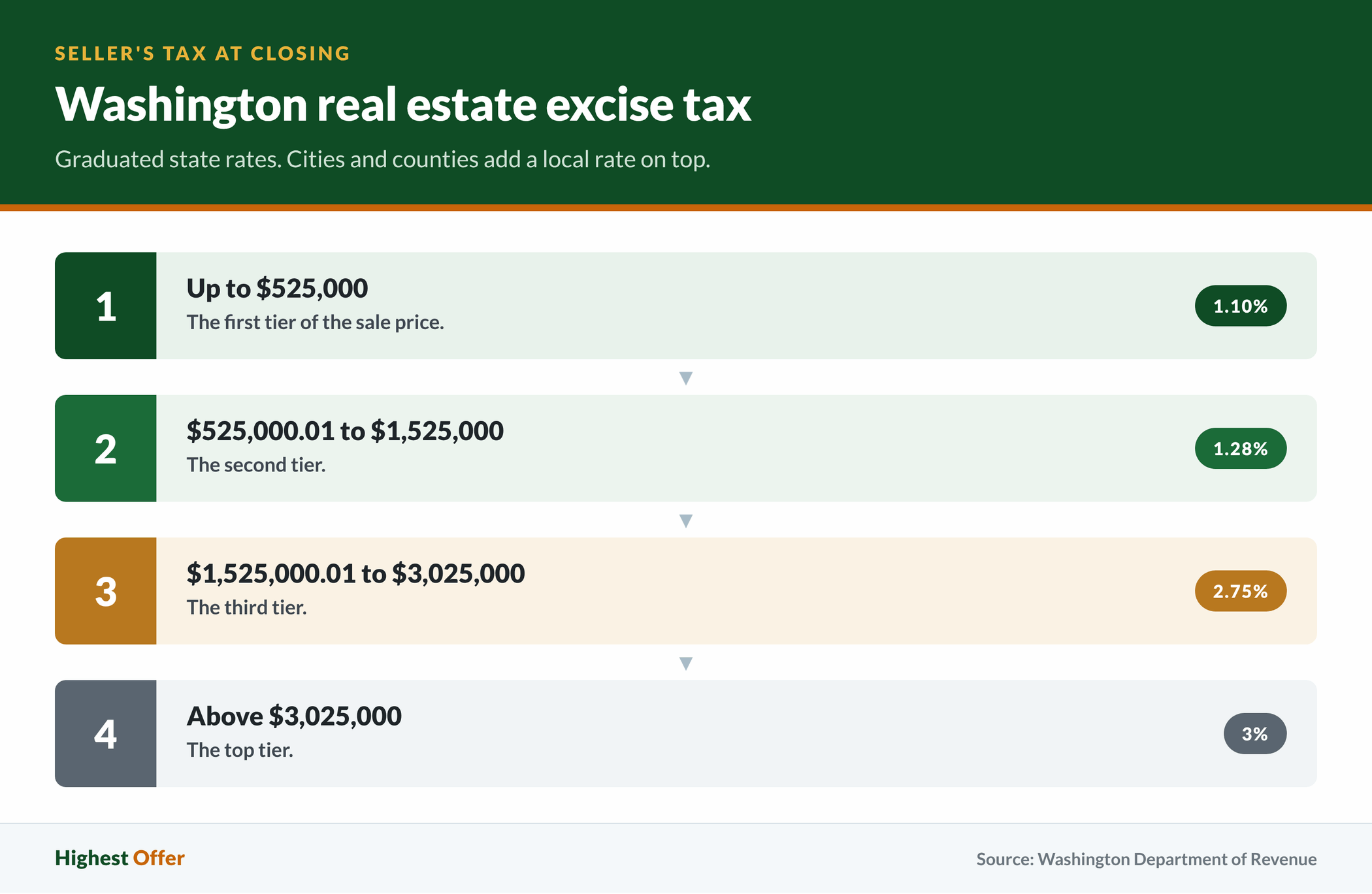
Then there’s the tax at closing, which Washington puts on the seller. The Department of Revenue publishes a graduated state structure for the real estate excise tax. It’s 1.10% on sales of $525,000 or less and 1.28% from $525,000.01 to $1,525,000. The rate rises to 2.75% from $1,525,000.01 to $3,025,000, and 3% above that. Cities and counties add a local rate on top, which you can confirm on the Department of Revenue’s REET page.
None of this blocks the sale of a hoarder house in Washington. It just means starting the title work before you start the dumpsters.
How Do You Find the Right Buyer for a Hoarder House in Washington?
Title work also tells you something about buyers, because few people can close on a cluttered property.
Three groups reliably buy a hoarder house in Washington. Local investors renovate and resell. Landlords add to rental portfolios. A few owner-occupants with renovation financing will take on a long project.
Vet whoever shows up. Ask how many properties they’ve closed in your county this year, whether they’ll assign the contract, and how long their inspection period runs. A short, firm timeline with no assignment clause is worth more than a higher number that falls apart in week three.
Watch how they treat the contents. Some buyers want the house broom-swept before closing, which defeats the point for most families selling.
Ask what happens if their inspection finds something worse than expected. A buyer who’s thought it through already has an answer. I’d rather give a seller a slightly lower number I’ll honor than a headline price I’ll renegotiate twice.
Once a distressed property hits a public record, expect cash offers and wholesaler emails.
What Are the Fastest Ways to Sell a Hoarder House in Washington?
Speed costs money. For most families selling a hoarder house, it’s a trade worth making.
The fastest route is a direct cash sale with no financing contingency, no appraisal, and a title company already pulling the preliminary report. Two to three weeks is realistic in Washington once title is clear. Probate stretches that timeline, and so does an unreleased lien nobody knew about.
Second fastest is an as-is MLS listing priced aggressively for investors. You’ll field more offers, and you’ll also field showings. Walking strangers through a Washington hoarder house is exactly what most sellers want to avoid.
Pricing honestly beats every other speed tactic. A property priced for its condition on day one moves. One priced for its potential sits while carrying costs eat the difference.
If you want one number to compare against everything else, Highest Offer Real Estate gives Washington homeowners a condition-based cash offer with no cleanout requirement attached.
Frequently Asked Questions
Do I Have to Tell Buyers the Property Was a Hoarder House?
You have to disclose known material facts about the condition, and that’s where hoarding issues show up: pest activity, water intrusion, mold, damaged flooring. The statutory form asks about those directly. No particular label is required for the house, though hiding a known rodent infestation is how sellers end up in court after closing.
Will a Buyer’s Lender Approve a Loan on a Hoarder House in Washington?
Usually not on a conventional, FHA, or VA loan if the appraiser can’t reach the furnace, water heater, and electrical panel. That’s the biggest single reason these transactions fall apart late. Renovation loans like the FHA 203(k) can work for the right buyer, though they add weeks and plenty of paperwork.
How Much Less Will I Get for a Hoarder House Than a Clean One?
Plan on a meaningful discount from what your home would bring in good condition, in the range I covered earlier. The spread narrows when the structure, roof, and systems are sound and the problem really is just contents. It widens fast with animal waste, standing water, or a crawlspace nobody’s opened in years.
Can I Sell a Hoarder House in Washington If My Parent Is Still Living?
Yes, as long as your parent has the legal capacity to sign or has given you a durable power of attorney that covers real estate. Plenty of Washington families sell this way after a parent moves into assisted living. Bring the power of attorney document to escrow early, since title companies review that language carefully before they’ll insure the transaction.
Does a Cash Sale Still Require the Form 17 Disclosure?
In most residential transactions, yes, even when the buyer pays cash and takes the property as-is. The statute has a few narrow exemptions, and a buyer can sometimes waive receipt in writing, though the environmental section follows its own rules. Your closing agent will tell you which category your sale falls into.
Talk With Us About Your Hoarder House
If you’re sitting with a hoarder house in Washington and can’t tell what it’s worth, or whether cleaning it out makes financial sense, I’m happy to look at it with you. You’ll get a straight number and an honest read on your options, including the ones that don’t involve selling to us. There’s no pressure, no obligation, and no judgment about what’s inside.
Whenever you’re ready, reach out to Highest Offer Real Estate and we’ll talk through what the house is worth as it stands. If you’d rather start in writing, fill out the short form below and we’ll follow up. You won’t get any judgment about what’s inside.