
Seller Guide
How to Sell a Probate House in Washington State
We buy probate homes across Pierce, King, Thurston, Mason, Kitsap and Snohomish counties, as-is and on the estate’s timeline. Fill out the form to get a written cash offer you can share with the other heirs.
- Cash offers in 24 hours or less
- We buy homes in as-is condition
- No cleaning or junk removal
- No inspections or contingencies
- Close on the estate’s timeline
- No commissions or fees
Get Your Cash Offer
Tell us where the house is and the best way to reach you.
A house doesn’t stop costing money because its owner died. Property taxes keep arriving in the mailbox, the gutters still fill with Douglas fir needles every October, and insurance carriers get nervous about vacant homes. Probate lives in the gap between “we inherited a house” and “we can legally sell it,” and in Washington it’s shorter than almost anywhere else in the country.
What Does Probate Mean for Washington Homeowners?
One of the friendliest probate systems in America is run by Washington, and most families here are stunned when they find that out.
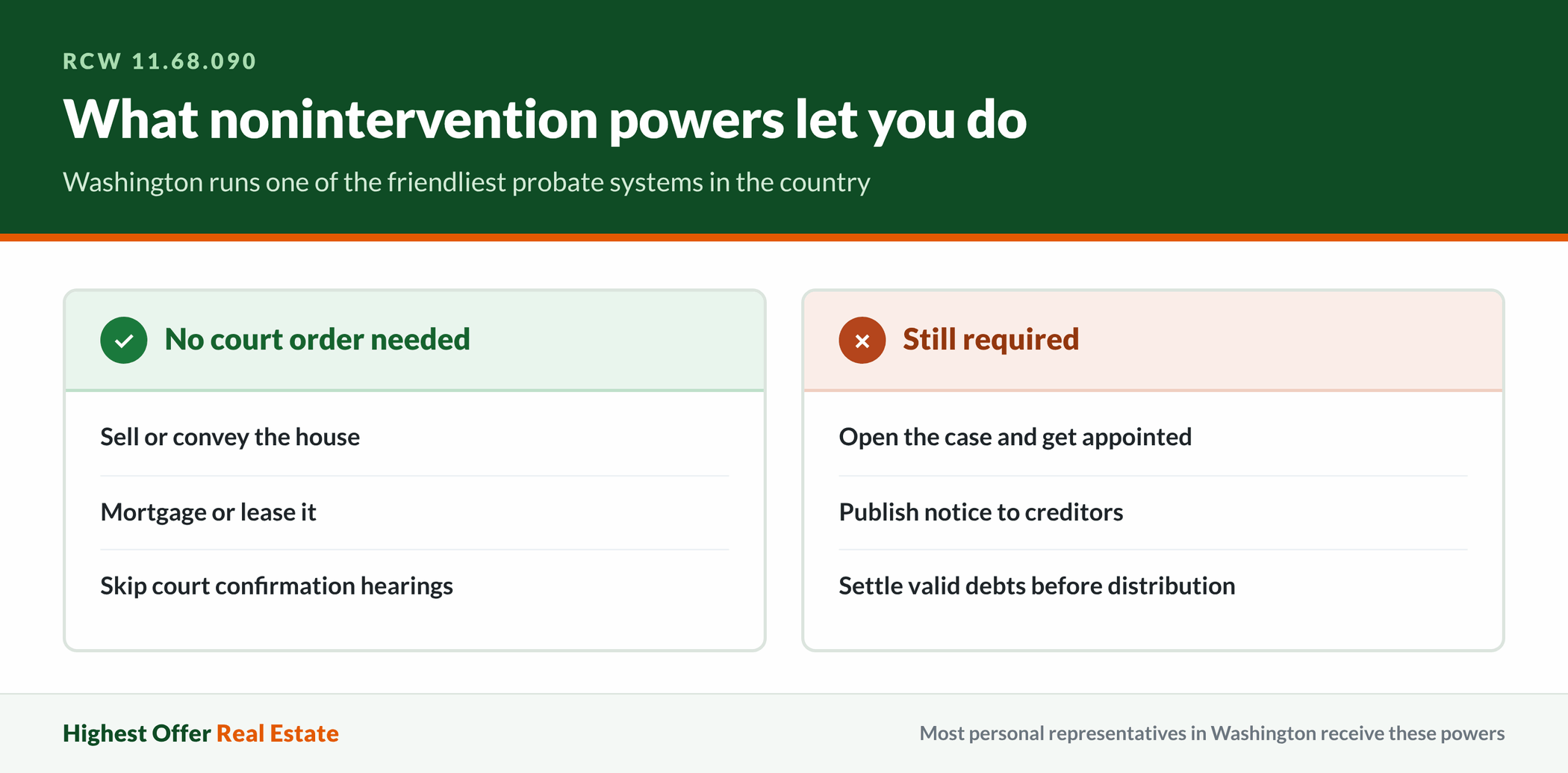
The reason is a provision called nonintervention powers. Probate in Washington is handled through the Superior Court in each county, so the court appoints a personal representative. In most cases, this representative receives nonintervention powers under RCW 11.68. This allows administration of the estate with little or no ongoing court supervision. In plain terms: once a judge signs off, you’re not running back to the courthouse for permission every time you want to do something.
Selling the house falls under the nonintervention powers too. Under RCW 11.68.090, a personal representative holding these powers can sell, convey, mortgage, lease, or otherwise transfer the decedent’s real property. That takes no court order and no notice to, approval by, or confirmation from any court. Families in California or Florida pay for court confirmation hearings and overbid auctions, while Washington probate skips that circus entirely.
Does that mean probate is painless? No. You still have to open the case, get appointed, publish notice, and handle creditors. But the sale itself stops being the bottleneck.
A while back I worked with a longtime landlord in Puyallup who got a job transfer, and he had just five weeks to be out of the state. He’d inherited the duplex from his mother and was midway through probate, convinced he’d be stuck until a judge freed him. His attorney confirmed nonintervention powers were already in place, and we closed before his moving truck left Pierce County.
Most Washington estates with real property go through standard probate rather than any shortcut, because real estate pushes the value past every simplified threshold. Knowing that early saves you from chasing workarounds that don’t exist.
What Happens When Someone Dies Without a Will in Washington?
An Everett woman called me about her father’s split-level after he passed with no will in a drawer anywhere. She assumed the house would be frozen for years and that the state would take a cut.
Neither was true. Washington’s intestacy statute lays out exactly who inherits, and probate moves along a similar track with or without a will. RCW 11.04.015 gives the surviving spouse or state registered domestic partner all of the decedent’s share of the net community estate. The survivor also takes one-half, three-quarters, or all of the net separate estate, depending on who else survived.
Community property changes the math here more than anywhere else. Because the community half consolidates in the survivor, a Washington couple’s family home frequently ends up wholly owned by the surviving spouse even when no will exists.
In intestate estates, the court appoints an administrator rather than an executor named in a last will and testament. This person still petitions for nonintervention powers. RCW 11.68.011(1) allows a personal representative to petition for those powers whether the decedent died with a will or without one.
What slows down intestate probate in Washington isn’t the law. It’s the heirs. When four siblings each have a different idea about what Dad’s house in Lakewood is worth, the probate court isn’t the obstacle; the Thanksgiving table is. Get agreement in writing early, even informally.
Bond requirements sometimes apply to an administrator in intestate Washington probate, which adds cost. Ask the attorney about that at the first meeting rather than discovering it on an invoice.
Can You Inherit Real Estate Through a Will in Washington?
Before: a Kent family believed Mom’s handwritten note about who got the house was enough to transfer title. After: the title company refused the closing, and they opened probate eleven weeks later than they needed to.
Yes, you can inherit real property through a will in Washington. The will names beneficiaries and the property passes to them, but it’s not instant and not automatic. A will is a set of instructions to the probate court, not a deed. Until the estate goes through probate and the personal representative either sells the house or distributes it, the heirs hold an expectation rather than clean, insurable title.
Transfer on death deeds are recognized in Washington, letting real estate bypass probate completely when recorded before death. Check the county recorder’s office for Pierce, King, Snohomish, or wherever the property sits before assuming probate is required at all.
The other common bypass is joint tenancy with right of survivorship. Two names on the deed, one person dies, the survivor owns it. No probate case, no court, no waiting.
Title companies are the real gatekeepers in Washington probate sales. I’ve had closings where the attorney, the heirs, and the buyer all agreed on everything, and the title examiner still wanted an additional document from the probate file. This isn’t obstruction; it’s the system working. Get your attorney and the escrow officer talking in week one instead of week twelve.
If the will names a personal representative who has since died or moved overseas, the court appoints someone else. A few weeks, rarely more, is what that detour adds to Washington probate.
Do You Need Probate or an Affidavit of Heirship in Washington?
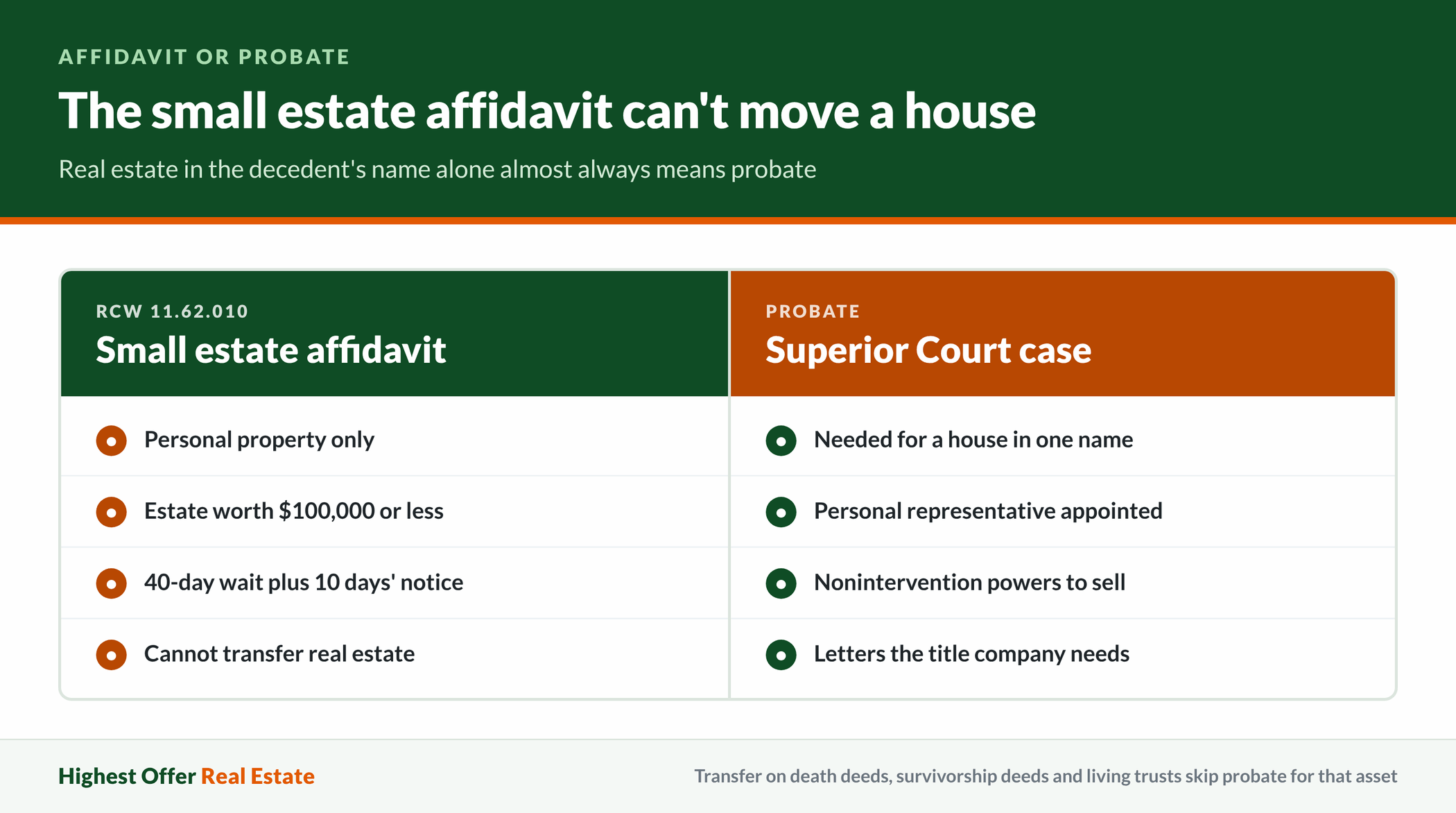
Washington’s small estate affidavit cannot transfer real estate. That single fact resolves most of the confusion I hear on this subject.
The small estate affidavit under RCW 11.62.010 lets a successor collect a deceased Washington resident’s personal property, including bank accounts, vehicles, and securities, directly from whoever holds it. No full probate case is needed when the entire probate estate is worth $100,000 or less. That route requires a 40-day wait after death plus 10 days’ notice to other successors.
Houses don’t qualify. Worse, if the total including the decedent’s equity in real property exceeds the cap, the affidavit isn’t available at all, even when the property itself will pass by some other route. Given what Washington homes are worth, almost any estate holding a house blows past that ceiling on the first line of the worksheet.
So where does that leave you? Probate, in nearly every case where real property sits in the decedent’s name alone. Washington has no separate affidavit of heirship for real estate the way some southern states do. Articles written for a national audience muddle this constantly, and I’ve watched families waste two months on a form that was never going to work.
The exceptions are worth confirming before you file anything: community property agreements between spouses, recorded transfer on death deeds, survivorship deeds, and property already titled in a living trust. Each one skips Washington probate for that specific asset, which means your probate attorney can review the deed in twenty minutes and tell you which bucket you’re in.
Ask that question before you pay a retainer. It’s the cheapest hour you’ll spend.
How Long Does Probate Take Before You Can Sell a House in Washington?
Four months is the floor, and it’s written into the statute.
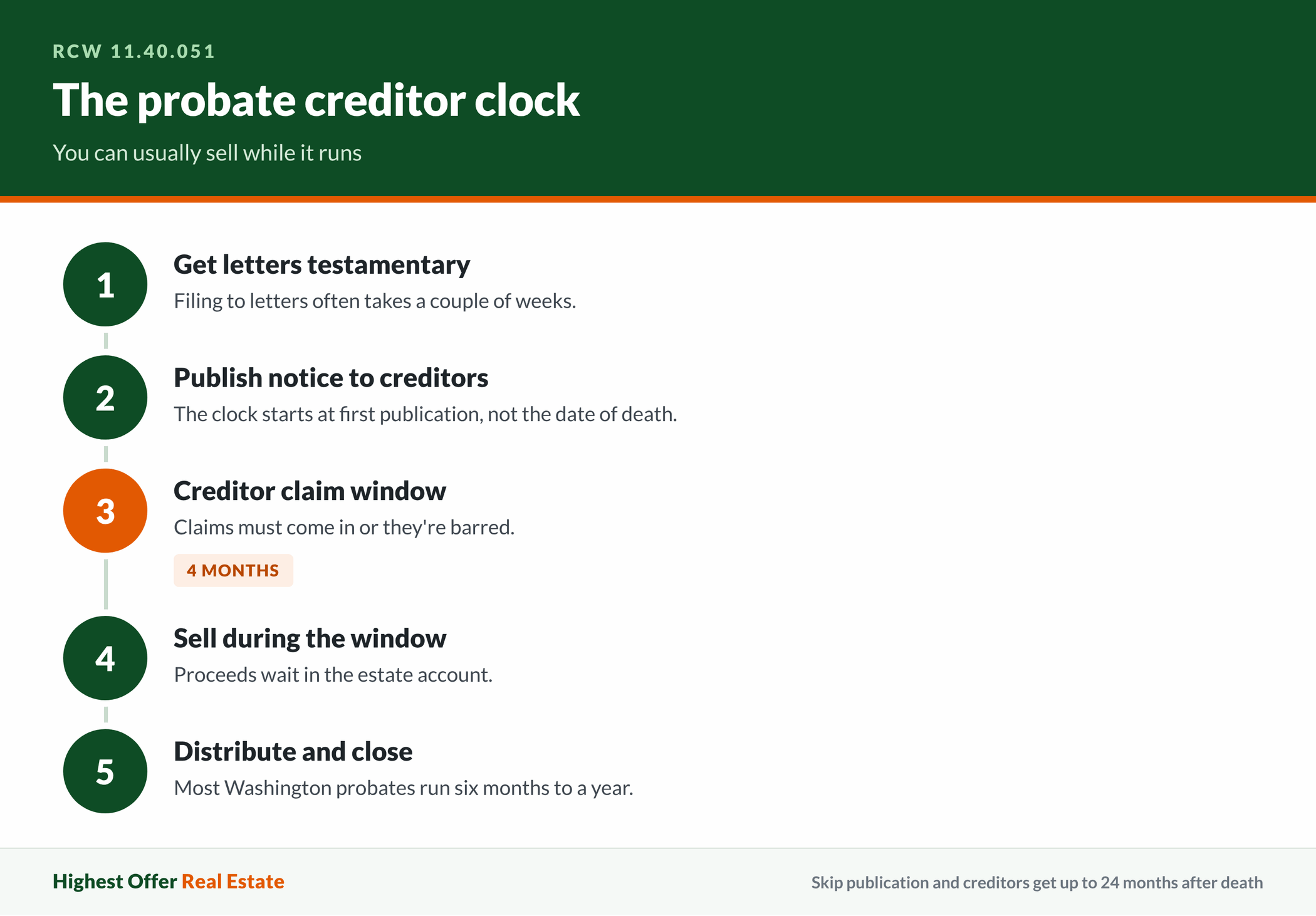
Under RCW 11.40.051, a creditor generally must present a claim within four months after the first publication of the notice to creditors or be barred. Most Washington probates run six months to a year, with that window setting the minimum. The clock starts at first publication, not at the date of death and not at the date the court appoints the personal representative.
Skipping publication is a trap. When notice isn’t given under the statute, a creditor can have up to twenty-four months after the date of death to present a claim. Four months of patience beats two years of exposure.
Now the part that surprises people: you can usually sell the house during those four months, since nonintervention powers don’t wait for the creditor window to close. Many Washington personal representatives list or sell early and hold proceeds in the estate account until the claim period runs out.
So how does timing actually play out? Statewide, homes sold over a rolling 90-day period in October 2026 spent a median of 28 days on market, with King County posting a $840,000 median sold price. Seattle homes were selling in a median of 22 days active with a citywide median price of $835,000 as of October 2026. Add escrow and you’re roughly two months from listing to funding, comfortably inside the creditor period.
Filing to letters testamentary often takes a couple of weeks.
What Should You Know Before Selling a Probate House in Washington?
And that market timing cuts both ways, because inherited houses rarely show like the competition. Seattle’s median sold price was down 2.9% year over year in October 2026, and softer markets punish dated properties harder than hot ones. I’ve walked through enough of these to know a 1978 rambler in Kent with original carpet competes against renovated flips with staged furniture.

Vacancy is the expense nobody plans for, because most homeowner policies restrict or void coverage after a property sits empty for 30 or 60 days, and insurers want a vacant dwelling policy instead. Call the carrier the week probate opens. A burst pipe during a February freeze will cost the estate more than the entire probate attorney’s fee.
There’s no state inheritance tax in Washington. The estate tax is separate, applies only above a threshold the Department of Revenue publishes and adjusts, and most families never touch it. Heirs also get a stepped-up basis, meaning capital gains are calculated from the value at the date of death rather than what Grandpa paid in 1962. That alone often means little or no tax on a prompt sale.
Disclosure rules relax for personal representatives who never lived in the house. You still can’t conceal known defects, but Washington’s seller disclosure statement includes accommodations for fiduciaries, so check the current form with your attorney rather than guessing.
Cleanout costs more than dollars, since sorting a full house can take weeks. Factor that honestly into your timeline. Teams like Highest Offer Real Estate buy probate properties as-is specifically so heirs can skip the sorting marathon entirely.
Keep every receipt. Probate accounting in Washington is less formal under nonintervention powers, but beneficiaries can still demand documentation.
What Are the Steps to Sell a House in Probate in Washington?
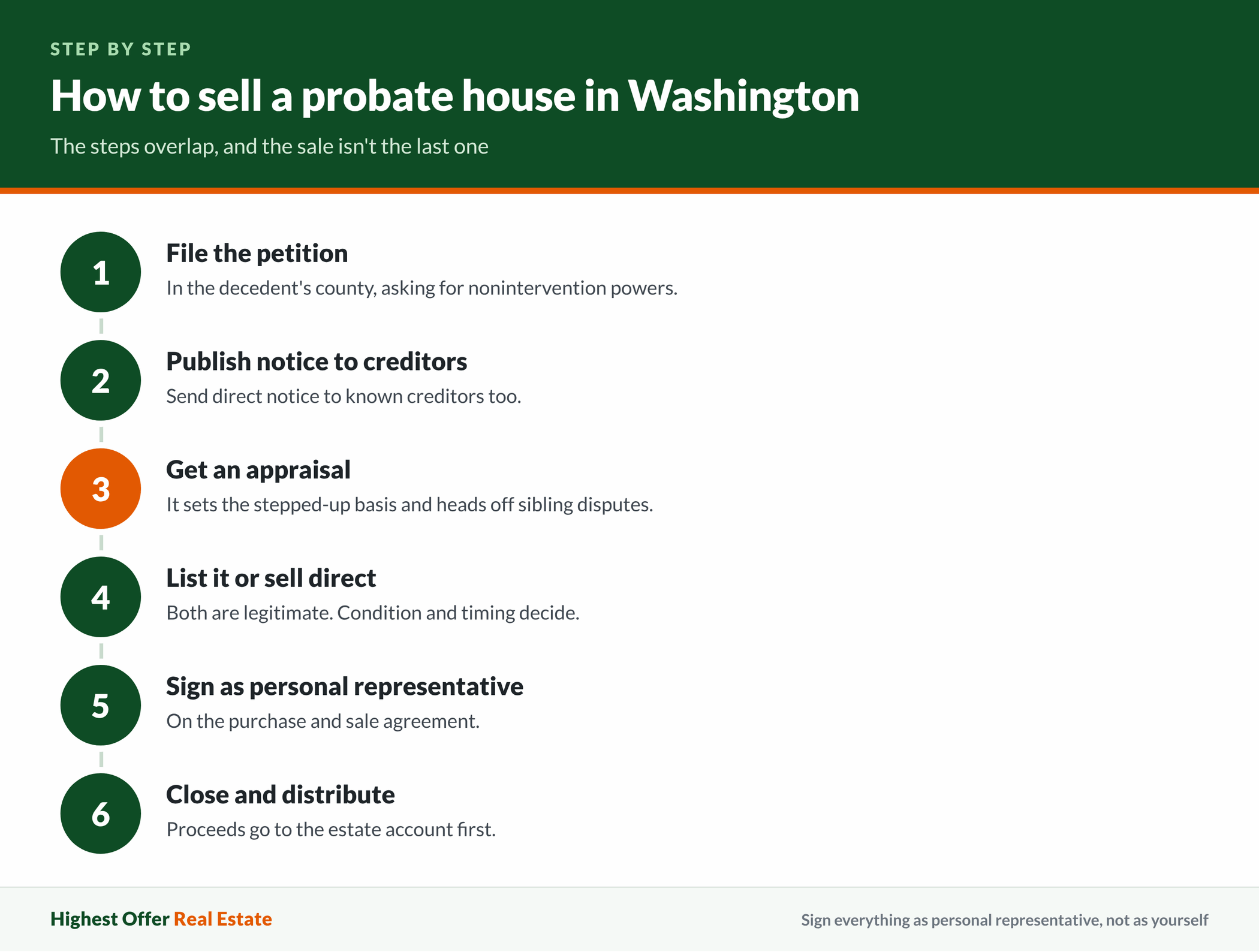
“My attorney said this takes a year, so why bother starting now?” Because the steps overlap, and the sale isn’t the last one.
Step one is locating the original will and filing a petition with the Superior Court in the county where the decedent lived. The petition should also request nonintervention powers under RCW 11.68. Those letters are what the title company needs.
Second, publish the notice to creditors in the county’s legal newspaper and start the clock. Direct notice should also go to known creditors, which shortens their individual claim window.
Third, get an appraisal or broker opinion. It anchors the stepped-up basis and protects you from a beneficiary who later claims the house sold too cheap. This is the step families skip, and it causes more sibling litigation in Washington probate than any pricing decision.
Fourth, decide between listing and selling direct. Both are legitimate. Pierce County showed a $566,250 median sold price with 26 median days on market in October 2026, so a well-priced retail listing there can move in about a month.
Fifth, sign the purchase and sale agreement as personal representative, not as yourself.
Sixth, close. Proceeds go to the estate account, not to individual heirs, until the creditor period ends and the personal representative distributes. Washington probate then wraps with a declaration of completion filed with the court.
Can a Cash Buyer Speed Up the Washington Probate Process?
Let me be straight about what a cash buyer can and can’t do: we can’t shorten the four-month creditor window, and anyone who tells you otherwise is selling something.
What we can compress is everything else. A probate sale that would take two months of retail marketing plus a 30-day escrow can fund in under two weeks once letters testamentary are in hand.
That matters most when the estate is carrying costs it can’t afford. With prices softening across Washington, an heir paying a mortgage, utilities, and vacant-dwelling insurance on an empty house is watching the estate shrink every month.
The other thing a cash buyer removes is the condition problem. Washington probate houses frequently have deferred maintenance: a moss-covered roof in Everett, a crawlspace that’s been damp since the Obama administration, knob-and-tube wiring an FHA appraiser will flag immediately.
Is a direct sale right for every probate estate? No. If the house is in good shape, the heirs aren’t in a hurry, and somebody local can manage showings, a retail listing usually nets more. An honest buyer should be able to tell you when listing beats selling direct.
A woman in Olympia inherited a 1960s rancher from her aunt. It was packed floor to ceiling with thirty years of accumulation. This included a garage with four non-running snowmobiles and a chest freezer nobody wanted to open. Her two siblings wanted a clean exit and zero weekends spent sorting, so we bought it as-is on a Tuesday with everything still inside, and the family kept three boxes of photographs.
Frequently Asked Questions
How Do You Start the Probate Process in Washington State?
You file a petition with the Superior Court in the county where the person lived, along with the original will if one exists. Then you ask the court to appoint a personal representative with nonintervention powers. The clerk issues letters testamentary once the judge signs, and those letters are the document that lets you act for the estate. Most Washington probate attorneys handle the filing in the first week or two after you hire them, and many counties now accept electronic filing.
Can You Sell an Inherited House While It’s Still in Probate?
Yes, and in Washington it’s routine. A personal representative holding nonintervention powers can sign a purchase and sale agreement and convey the property without asking a judge for permission. The sale proceeds land in the estate account rather than going directly to the heirs, and distribution waits until the creditor claim period described earlier has run and valid debts are settled.
Who Legally Owns a Home During Probate?
The estate owns it, and the personal representative controls it. Beneficiaries named in a will hold a right to receive the property or its proceeds, but they can’t sell it, refinance it, or move a tenant in while probate is open. That distinction trips up families where one sibling has lived in the house for years and assumes possession equals ownership; it doesn’t until the deed is recorded in their name.
Do Heirs Pay Taxes on a Probate House in Washington?
Washington doesn’t impose an inheritance tax on heirs, so you’re not writing a check to the state simply for receiving property. The estate tax is a separate question that applies only to larger estates, and the Department of Revenue maintains the current filing threshold. Because of the stepped-up basis rule, a probate house sold near the date-of-death value often generates little or no capital gains tax for the heirs.
What If the Heirs Disagree About Selling the Probate House?
Disagreement is the most common delay in Washington probate, and it’s rarely a legal problem at root. The personal representative generally has authority to sell under nonintervention powers, but a beneficiary who objects can petition the court to restrict those powers, which turns a quiet administration into a contested one. Getting a neutral valuation early and putting the plan in writing prevents most of these fights before they start.
If you’re sitting on a probate house in Washington and you’re not sure whether to list it, fix it, or sell it as-is, we’re happy to walk through the numbers with you. No pressure, no obligation, and if listing with an agent makes you more money, we’ll tell you that too. Reach out to Highest Offer Real Estate whenever you’re ready to talk it through.
Selling a Probate House in Tacoma and Pierce County
Probate estates in Tacoma and across Pierce County run through the same Superior Court steps covered above. We work on the personal representative’s timeline and buy the house as it sits.
We also buy probate homes across Washington in the counties we serve.
Get a Cash Offer on Your Probate House
You can sell once the court grants the personal representative nonintervention powers, even while the creditor period runs. You’ll get a written as-is offer, usually within 24 hours, to share with the other heirs.
We buy probate homes across Pierce, King, Thurston, Mason, Kitsap and Snohomish counties, and we close when the estate is ready.
There’s nothing to repair or clean out first, and you won’t pay agent commissions. Fill out the form or contact Highest Offer Real Estate to talk it through.