

Two people who can’t agree on anything usually agree on one thing: the house has to get sorted out. The conversation I have most often with homeowners across Washington is rarely about real estate at first. It’s about who sleeps where, who pays the mortgage this month, and whether the kids change schools. A divorce in Washington puts your biggest asset on a table you both have to sit at, and the sooner you understand how the rules work, the fewer surprises land on you.
Who Gets the House in a Washington Divorce?
No one involved automatically gets the house. I say that first because almost every seller I meet walks in believing the mother keeps the home, or the person on the deed keeps the home, or whoever filed first has an edge. That’s not how Washington works.
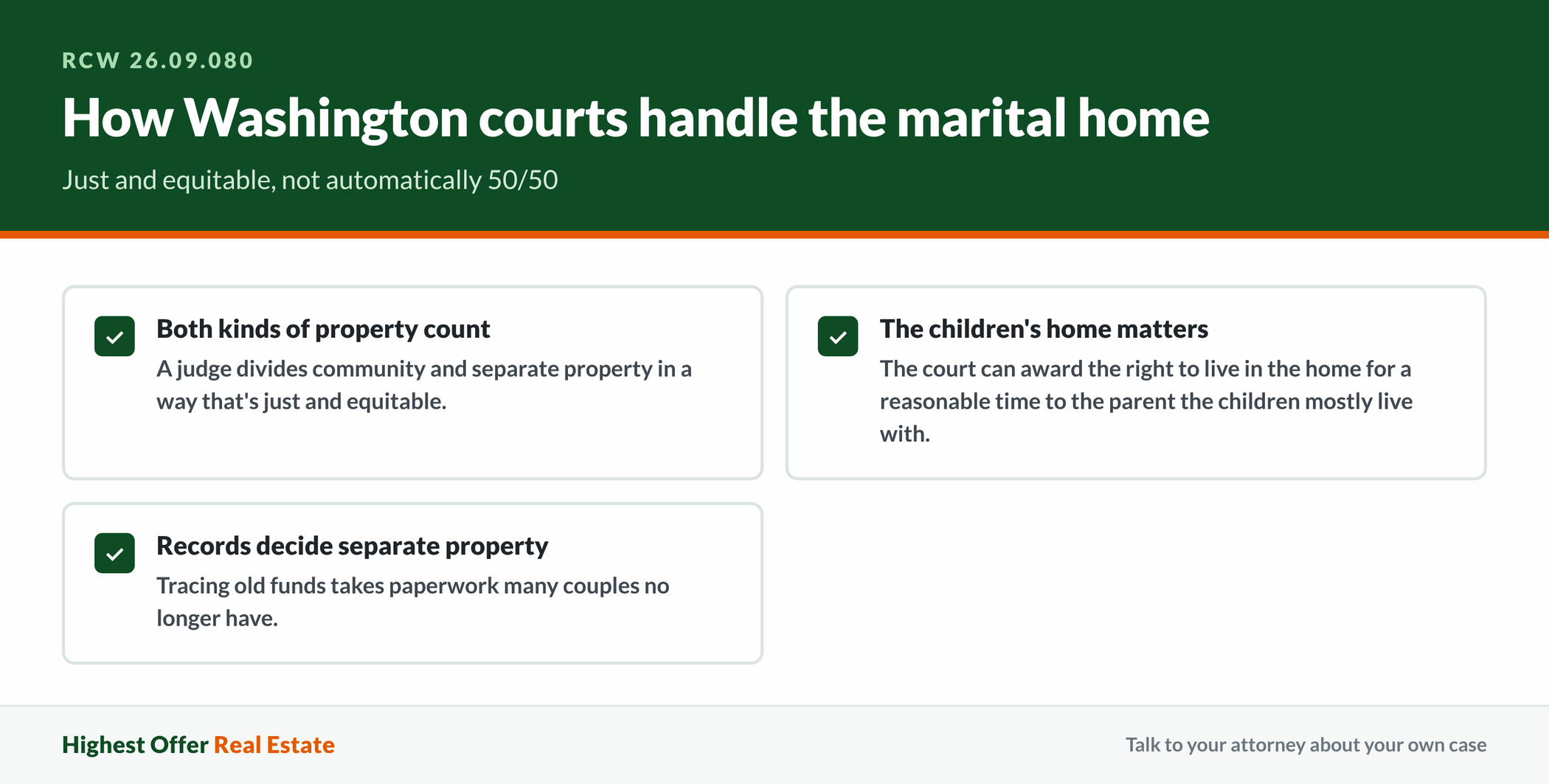
Washington is one of the community property states, so anything you and your spouse picked up during the marriage is presumed to belong to both of you equally. But presumption isn’t the same as outcome. Under RCW 26.09.080, a judge divides both community and separate property in a way that’s just and equitable. The judge weighs the property itself, the length of the marriage, and each spouse’s economic future. In a divorce, Washington courts do not automatically split property 50/50. You can read the plain-language breakdown of that standard at Anderson Hunter Law.
Children shift the math. RCW 26.09.080 lets the court award the right to live in the home for a reasonable time to the parent the children mostly live with. A sale is to come later, so it’s a delay rather than a gift. Plenty of parents hear “you can stay” and assume the house is theirs forever, then face a sale three years into a divorce they thought was finished.
A couple of years ago I sat with a retired couple in Puyallup whose divorce had stalled over a kitchen. Their contractor’s estimate to redo it came back higher than the kitchen would ever add to the sale price, and they’d both been waiting on that remodel before listing. We bought it with the 1970s cabinets still in place and they split the proceeds that quarter.
Who should get the house? It depends less on fairness and more on who can carry it alone.
How Washington Courts Divide the Marital Home
Separate property isn’t off-limits in a Washington divorce. Washington is an all-property community property state, which means the court can reach both community and separate property to arrive at a just and equitable result. Usually skipped, that detail changes how you negotiate.
Judges don’t guess at value. Courts typically rely on professional appraisals from licensed appraisers, with equity divided according to the four statutory factors. Those four factors are the nature and extent of community property, the nature and extent of separate property, how long the marriage lasted, and each spouse’s economic circumstances at the time of division.
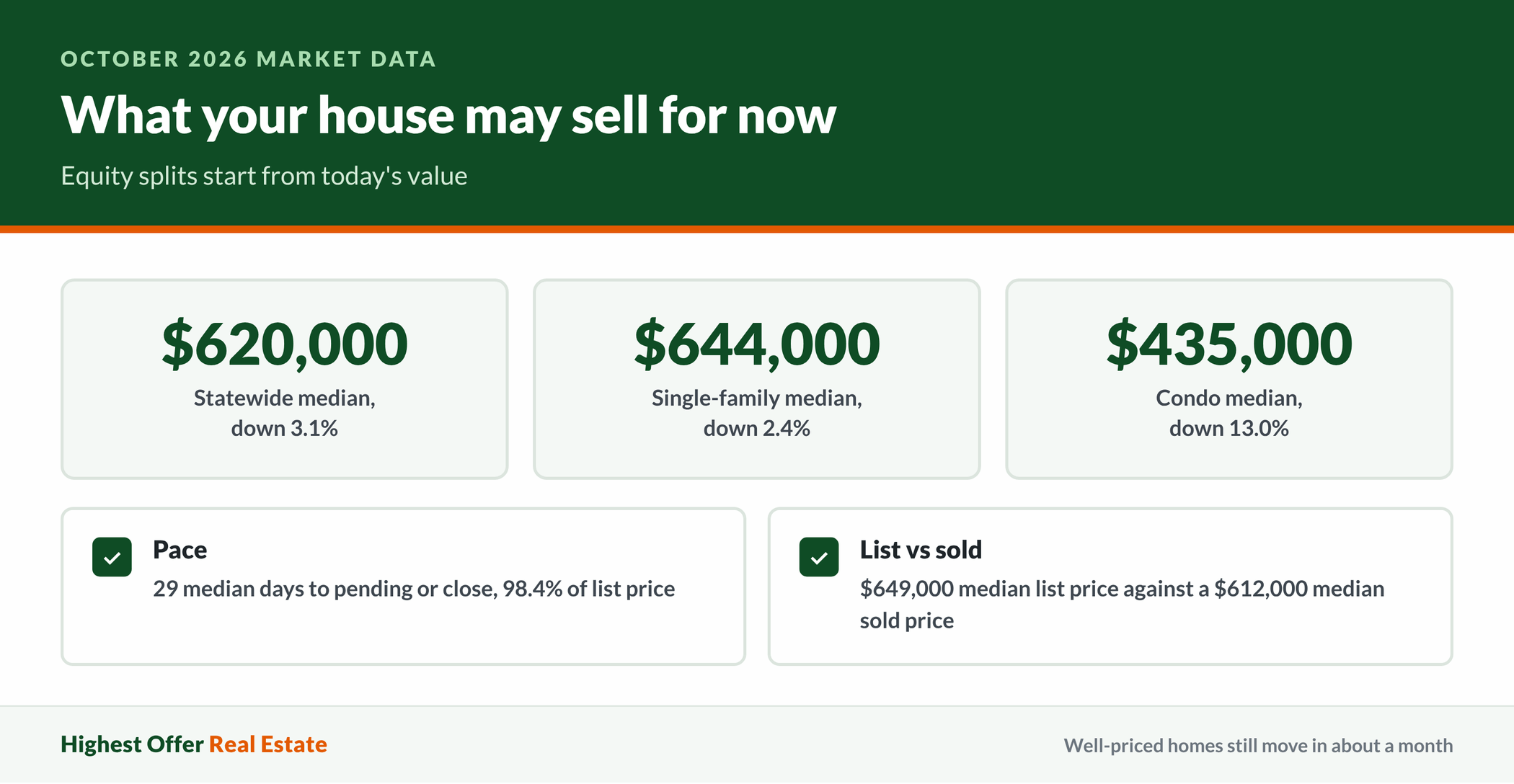
Here’s where the valuation question gets practical in Washington. An appraisal is a snapshot, and your divorce may run months past the date it was written. Statewide, the median sales price for homes and condos sold in October 2026 was $620,000, down 3.1% from October 2025. A softening market means a spring appraisal can overstate what a fall closing actually delivers.
Divorce courts can order the sale outright. Under the same statute, the court may order the home sold and the proceeds divided according to community property rules. Once the divorce order exists, you’ve lost control over timing and often over method.
My opinion, stated plainly: fighting over a buyout number you can’t finance is the most expensive mistake in a Washington divorce. I’ve watched couples burn tens of thousands in attorney hours arguing over a figure neither one could qualify for at a bank. The equity shrinks while the lawyers bill.
Mediation gets you to the same place faster, and a mediator won’t order anything you both didn’t agree to.
How Separate Property Rules Affect Your Divorce Settlement
Before: a woman inherits her grandmother’s bungalow in Tacoma’s North End, keeps it in her name alone, and marries five years later. After: fifteen years of joint paychecks have gone into the roof, the furnace, and the mortgage, and her husband’s divorce attorney has a strong argument about commingled funds.
Separate property quietly stops being separate this way. Community money poured into a separate asset creates a claim, and untangling it takes records most people never kept. Cancelled checks from 2011 aren’t in anybody’s filing cabinet.
A prenuptial agreement changes this conversation entirely, and it’s the single cheapest piece of paper in family law. If you signed one before the marriage, bring it to your attorney on day one of your divorce. Same goes for a premarital agreement executed after a prior divorce, since these documents do real work when they’re drafted properly.
Did one of you own the house before the wedding? Then the character of that property is a live question, not a settled one. A house can be one spouse’s separate property, yet still get awarded, in whole or in part, to the other spouse if a just and equitable result requires it. The analysis at NAWS Law walks through how Washington courts characterize assets first and divide them second.
Debt follows the same logic. The statute directs the court to divide liabilities along with property, and debts taken on during the marriage are generally community debts, though the court can assign them however it considers just and equitable. A home equity line one spouse drew down alone can still land on both of you in a Washington divorce.
Keep your paperwork. Bank statements, the original closing file, receipts for major improvements: these are what separate property arguments live and die on.
What Happens to Rental Properties and Land in a Washington Divorce?

Snohomish County’s median sold price sat at $699,000 as of early October 2026, with homes going pending in a median of 26 days, according to Beyond Real Estate’s market report. Numbers like that are why rental properties complicate a Washington divorce more than the family home does.
Rentals carry income, and income carries tax consequences, tenants, and depreciation recapture. A duplex you’ve owned for twelve years isn’t a number on a spreadsheet; it’s an operating business with a repair budget and a vacancy history. Splitting it means one of you buys the other out, you sell it, or you stay business partners with your ex after the divorce.
That third option sounds reasonable in a mediation room. It almost never survives contact with a broken sewer line.
Raw land is its own animal. Acreage in rural Thurston County or out past Eatonville can take far longer to move than a tract home in Kent, and lenders treat it differently, so appraisals end up mattering even more. Appraisers disagree about land more than they disagree about houses, which gives both sides in a divorce room to argue.
Who’s been managing the rentals? That matters in a Washington divorce, because the spouse who’s never collected rent or chased a late payment often underestimates the work involved. I’ve bought rental portfolios from divorcing owners where one spouse genuinely didn’t know which units were occupied.
For landlords in a divorce who’d rather not run a property with a soon-to-be ex, selling the rentals and dividing cash is clean. Highest Offer Real Estate handles tenant-occupied properties across Washington without asking anyone to empty the units first, and that saves a step most listings require.
Commercial parcels, mobile home lots, and timber ground all need valuation specialists, not general residential appraisers.
Should You Sell the House During Your Divorce?
Most couples should sell, and they should decide early rather than letting a judge decide for them.
Keeping the house feels like stability, especially with children in the picture. Refinancing into one name requires qualifying on one income, and that’s where the plan usually breaks. A refinance at current rates on a Washington home priced near the statewide median means a payment that two incomes carried comfortably and one income doesn’t.
Run the number before you fight for the house. Your lender can pre-qualify you in a week.
Selling converts a disputed asset into divisible cash, which is the whole point. Homes that sold during the rolling 90-day period ending October 7, 2026 took a median of 29 days to go pending or close, and sellers received 98.4% of list price on average. That’s a reasonable market for a traditional listing, as long as you both cooperate on showings, pricing, and repairs.
Getting both sides to actually agree is the catch. A listed house in a contested divorce needs two signatures on every price reduction and every inspection response. One spouse dragging their feet can kill a sale in escrow, and I’ve seen that pattern enough times to flag it as the real risk in a divorce sale.
Condo owners face a tougher road right now. The statewide median condo price declined 13.0% to $435,000 in October 2026, and the single-family median slipped 2.4% to $644,000.
Selling isn’t surrender. It’s the fastest way to stop two people from paying for a house neither of them wants to live in alone.
How Do You Time a Home Sale During a Divorce?
For years I told sellers to wait until the divorce was final before listing, and that advice cost people money. Closing after the divorce decree means two separate sellers, two sets of signatures, and sometimes two attorneys reviewing a purchase and sale agreement that should’ve been simple to begin with.
Selling while the divorce is pending, with both spouses still cooperating and a court-approved plan in place, usually goes smoother. Your attorneys can build the division of proceeds right into the divorce settlement.
Washington’s filing process has its own clock. A Washington divorce carries a 90-day minimum waiting period, with filing fees that vary by county. Your county clerk’s office can tell you the current fee and confirm the forms you need. Ninety days is enough time to list, go under contract, and close in most Washington markets, which is why the timing question is worth asking early.
Buyers in Washington care about seasons. Listings move better from April through July; the stretch between Thanksgiving and February is slower everywhere from Everett down to Olympia. If your divorce timeline lands you in January, a direct sale avoids sitting through the dead weeks.
What’s your actual deadline? Some sellers have a court date, some have a mortgage they can’t cover past spring, and those are different problems requiring different approaches.
Pricing during a divorce tends to run high because each spouse anchors to what they hope their half will be. The spread between the $649,000 median list price and the $612,000 median sold price statewide as of October 14, 2026 shows that overpriced listings sit while well-priced homes still move in about a month.
Price it for the market, not for the divorce settlement you wanted.
What Are the Tax Consequences of Selling a House in a Divorce?

“The state’s going to take a cut of my gain” is the first thing sellers say, and in Washington that’s not how it works. Washington’s capital gains tax doesn’t apply to real estate sales; the Department of Revenue lists real estate as exempt.
What you do owe is the real estate excise tax. The state portion runs on a graduated structure. Under the thresholds effective January 1, 2027, the rate is 1.1% on the portion of the price at or below $551,000. From there it’s 1.28% up to $1,551,000, 2.75% up to $3,051,000, and 3.0% above that. Current-year brackets and the local rate sheets are posted at the Washington Department of Revenue. On top of that, cities and counties add a local piece, commonly between 0.25 and 0.50 percent. The seller pays it at closing out of proceeds.

Federal tax is where divorce timing earns or costs you real money. If you have a capital gain from selling your main home, you may exclude up to $250,000 of it, or up to $500,000 filing a joint return with your spouse. You’ll satisfy the ownership test by owning the home for at least 24 months out of the five years before the sale date. Selling before the divorce is final lets you still file jointly, doubling your exclusion. Full details sit on the IRS Topic 701 page.

Talk to a CPA before you sign anything. A single conversation can save you more than the appraisal cost.
An heir in Olympia called me on a Tuesday last year, splitting assets in a divorce and sitting on a house she’d inherited mid-proceeding. Her brother’s boat was still in the garage and she didn’t want to spend a single weekend sorting it. We bought it as-is and she never had to drive over the pass again.
Frequently Asked Questions About Selling a House During Divorce
Do Both Spouses Have to Sign to Sell the House During a Divorce?
Usually, yes. Washington is a community property state, and under RCW 26.16.030 neither spouse can sell community real property unless the other joins in signing the deed. Title in one name doesn’t settle it, since a house bought during the marriage is presumed to be community property. A house that’s one spouse’s separate property can be sold by that spouse alone. That’s why tracing who paid for what matters so much in a Washington divorce.
Who Pays the Mortgage While the House Is for Sale During a Divorce?
Whoever your temporary orders or written agreement name. If both names are on the loan, you both stay on the hook with the lender until it’s paid off. A missed payment hurts both credit reports, no matter who moved out during the divorce. Plenty of couples split the payment and settle up from the sale proceeds at closing. That keeps the loan current and the house easy to sell.
How Are the Proceeds Split When You Sell a House During Divorce in Washington?
Escrow pays off the mortgage, the closing costs and the excise tax first. What’s left gets divided the way your divorce settlement or the court’s order says. Washington judges divide property in a way that’s just and equitable, so an even split is common but not automatic. If your agreement isn’t final by closing, your attorneys can have the net proceeds held in trust until it is.
Can One Spouse Buy Out the Other Instead of Selling?
Yes, if the spouse keeping the house can qualify for a new loan on one income. A buyout usually starts with an appraisal. The spouse who stays then pays the other their share of the equity, often through a cash-out refinance. Refinancing also takes the departing spouse’s name off the mortgage, which a quitclaim deed alone won’t do. When nobody can qualify, selling is usually the cleaner way to split the equity in a Washington divorce.
Can We Sell the House Before the Divorce Is Final in Washington?
Yes, and many couples do. You’ll want the division of proceeds spelled out in writing before closing, usually through your attorneys or your mediator, so escrow knows exactly where the money goes. Selling while you can still file a joint federal return is also what makes the larger exclusion described above available to you.
What If One Spouse Refuses to Sell?
A court can order the sale under the same just-and-equitable statute that governs the rest of the divorce. Before it gets that far, a direct cash offer sometimes breaks the logjam, because it removes the arguments about repairs, showings, and whether the agent priced it right. When there’s nothing left to negotiate except the number, people tend to come to the table.
If you’re working through a Washington divorce and the house is the piece you can’t figure out, we’re glad to look at it with you. We buy throughout Washington, as-is, on your timeline, and we’ll tell you straight if listing would serve you better. No pressure, no obligation, just a conversation whenever you’re ready.
Selling a House During Divorce in Tacoma and Pierce County
Divorcing couples in Tacoma face the same state rules on dividing the home. A clean sale with one closing date keeps both sides out of extra hearings.
Your divorce attorneys handle the split. We handle the house, on the timeline your agreement sets.
Talk Through Your Options
Contact Highest Offer Real Estate for a written as-is offer both of you can review.
You can also fill out the short form below. There’s no cost and no obligation.
Helpful Washington Blog Articles
- How to Sell a House without A Realtor in Washington
- How to Sell a House in Foreclosure in Washington
- Selling a House during Divorce in Washington
- Selling a House With Water Damage in Washington
- Selling Your Washington Home with Code Violations
- Can You Sell a House With Asbestos in Washington
- Who Pays Closing Costs When Selling a House in Washington
- Can You Sell A House With A Lien In Washington
- Selling a House That Needs Repairs in Washington
- Capital Gains Tax on Real Estate in Washington
- How Does Selling a House With a Mortgage Work in Washington
- Selling A House With Solar Panels In Washington
- How To File A Quitclaim Deed In Washington