Cement asbestos siding outlasts most of the people who installed it. Drive through Ballard, Tacoma’s Hilltop, or the older blocks of Bremerton and you’ll pass hundreds of houses still wearing the same shingles a crew nailed up in 1952. The material works. The uncomfortable part of this whole conversation is exactly why so many Washington sellers end up stuck between a buyer who panics and an abatement bid that eats their equity. You can sell. The rules are narrower than people fear and looser than agents sometimes claim.
What Does Asbestos Siding Look Like on a Washington House?
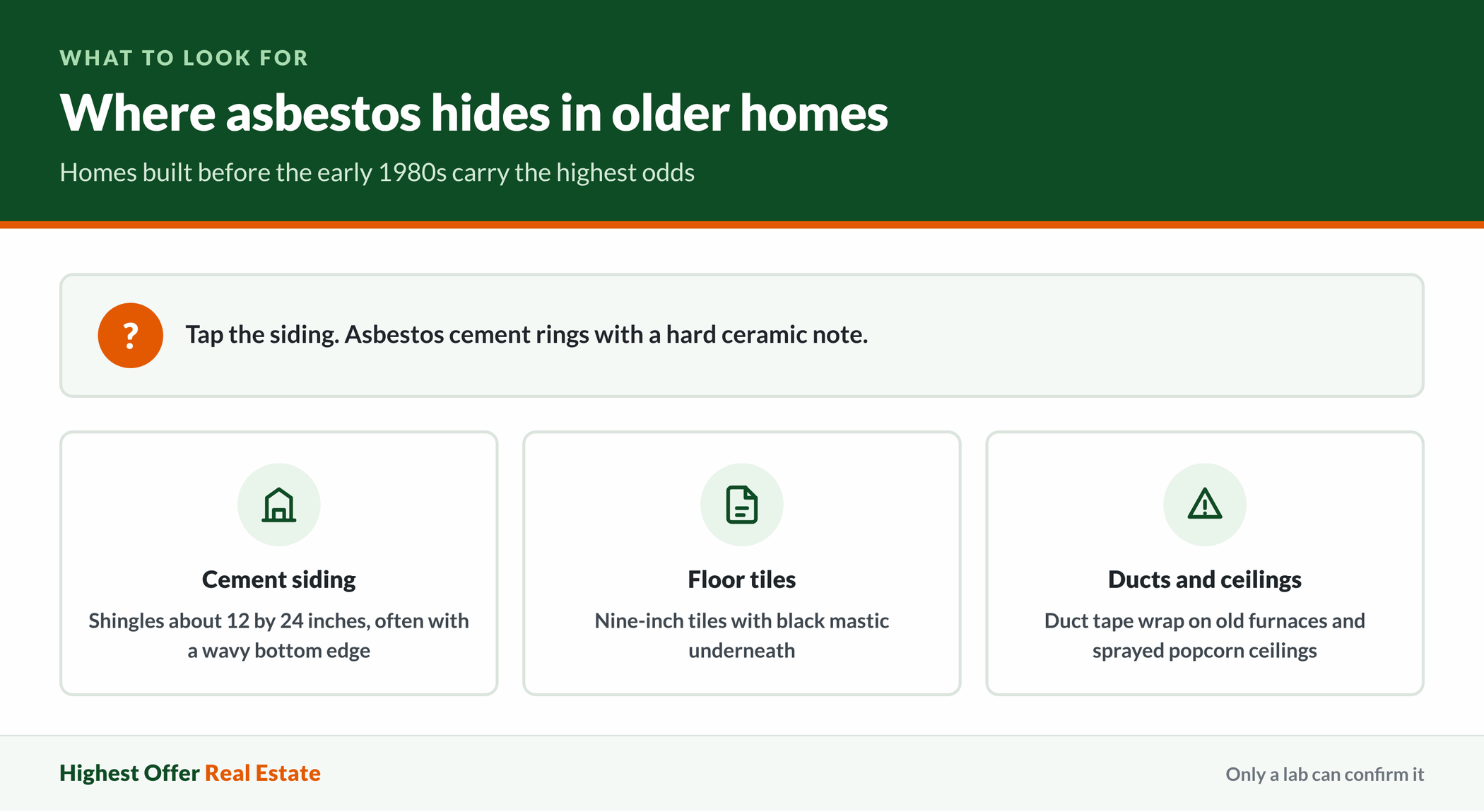
Asbestos cement siding rings when you tap it. Wood thuds, vinyl clicks hollow, and that hard ceramic note is the tell most Washington homeowners never think to listen for.
Check the shape next. Shingles roughly twelve by twenty-four inches, often with a wavy or scalloped bottom edge, sometimes with a faint woodgrain pressed into the face. Brittle corners that chip rather than dent. A chalky gray that’s gone green on the north side, because this is Washington and everything grows moss eventually.
There are other spots besides siding. Nine-inch floor tiles in a Tacoma basement, black mastic underneath, duct tape wrap on an old octopus furnace in Everett, popcorn ceilings sprayed in a Puyallup split-level. All of these are common homes for asbestos in this state.
I keep running into this pattern on walkthroughs. Sellers point at their siding and call it asbestos with total confidence, and half the time it’s cement board or hardboard from a 1970s re-side. The reverse happens too, so guessing out loud to a buyer is a bad habit since only a lab can actually tell you.
Homes in Washington built before the early 1980s carry the highest odds, though the regulatory history makes a clean cutoff impossible. A sweeping federal ban attempted in 1989 was largely overturned in court in 1991, so plenty of asbestos-containing products stayed legal. The EPA finalized a rule in 2024 to phase out chrysotile, the last type still being imported.
Sellers should care more about condition than presence. Intact, painted, undisturbed asbestos siding on a Washington bungalow behaves very differently than a cracked sheet someone pressure-washed last summer.
How Dangerous Is Asbestos in an Older Washington Home?
If your siding has been sitting there quietly since Eisenhower, leaving it alone is usually safer than tearing it off.
That surprises people. Asbestos hurts you when fibers go airborne and into your lungs, not when they’re locked in cement and covered in four coats of paint. Sanding, drilling, sawing, and demolition are what release them, so a weekend remodel does more damage than thirty years of weather.

The health risks are real, and I won’t soften them. Asbestos fibers are linked to mesothelioma, lung cancer, and asbestosis, and those diseases show up decades after exposure, so the lag itself is part of what makes this dangerous. Exposure to asbestos can cause mesothelioma and other respiratory cancers. No one in Washington should be casual about that.
Risk splits into two categories that Washington’s rules track closely: friable and nonfriable. Friable material crumbles under hand pressure, like old pipe wrap or ceiling texture, so it releases fibers with far less provocation. Nonfriable asbestos, meaning siding and most floor tile, stays bound until something breaks it.
Early last year a family out in Marysville called me about their late mother’s place. Thirty years of belongings, asbestos siding on three sides, a garage packed floor to ceiling with canning jars, and four siblings who lived in four different states and wanted one clean exit. We bought it as it stood, they kept the photo albums, and nobody had to argue over who was footing the abatement bill.
Would you rather disclose a known hazard or gamble that a buyer’s inspector misses it? The second option has never once worked out better in my experience.
Is It Legal to Sell a House with Asbestos in Washington?
In October 2026, Washington’s statewide median sold price over the trailing twelve months was $612,000, down 2.1% year over year. Plenty of the houses in that number contain asbestos. Selling them is completely legal.
No Washington statute forces you to remove it first. No federal or state law requires sellers to remove or remediate asbestos before selling, since disclosure where required by state law is the legal obligation, not removal. That’s the whole shape of it.
What Washington does regulate is the removal work itself, and the agencies involved catch people off balance, which means knowing who to call matters more than knowing the rules. According to a legislative report, Labor and Industries handles workplace asbestos standards in construction, while Ecology and local clean air agencies regulate removal from structures. The Puget Sound Clean Air Agency and ORCAA down in Olympia each run their own notification process.
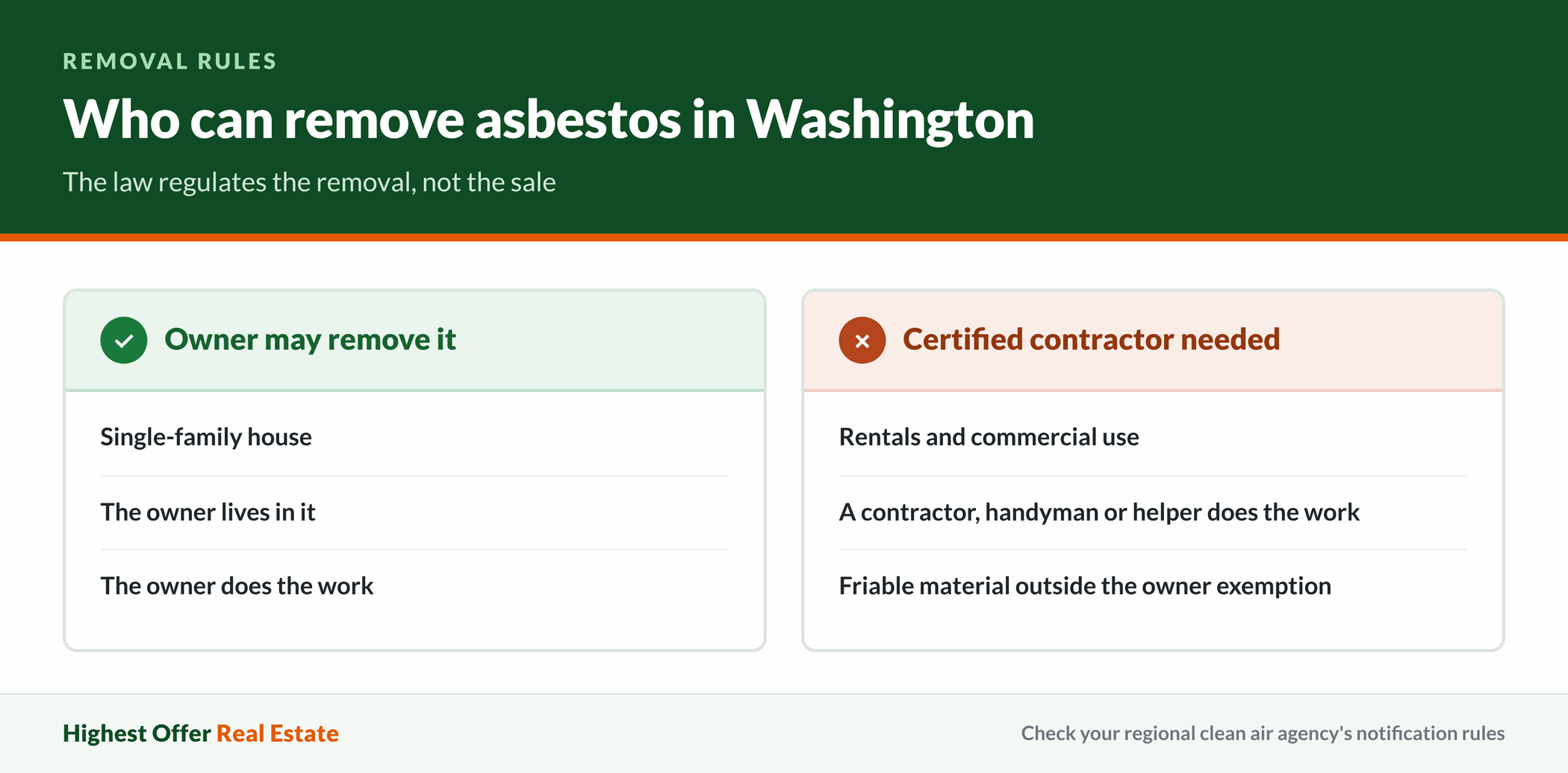
Owner-occupants get a narrow carve-out, though it’s easy to assume it covers more than it actually does. Friable asbestos must be removed by a certified abatement contractor unless the project is at a single-family house the owner occupies, which is the only exception where the owner may legally remove it. Bring in your brother-in-law, a handyman, or a tenant, and the exemption evaporates.
Rentals are not covered. Removal regulations apply if your residence is used for commercial purposes such as a rental, or if you bring in a contractor or other workers to disturb asbestos-containing materials. Landlords in Washington miss this constantly.
Confirm your local requirements before anyone touches anything. Your regional clean air agency publishes the notification forms and fees, and the Puget Sound Clean Air Agency walks through the options plainly for western Washington properties.
What Do Sellers Need to Disclose About Asbestos in Washington?
Do I have to say something if I only suspect it?
Short answer: disclose what you know, don’t invent what you don’t. Disclosure in Washington runs through a document you’ve probably already heard about. Sellers are legally required to disclose known material defects, including the presence of asbestos, through the Seller Disclosure Statement, also known as Form 17.
The form has an environmental section, with a wrinkle buried in it. Washington law lets a buyer waive receipt of the disclosure form, but if the answer to any question in the environmental section would be yes, the buyer can’t waive receipt. So an asbestos answer locks the disclosure into the sale permanently.
Testing isn’t a requirement for sellers. If the seller has no knowledge of asbestos, they can state that, and they are not required to test for it. Prior work counts too: if asbestos was removed or encapsulated, that history should be disclosed.
My opinion, and some agents disagree with me here: over-disclosing beats strategic vagueness every single time. Attach the lab report. Attach the abatement invoice. A buyer who reads “asbestos siding, tested 2024, intact, see attached” negotiates. A buyer who discovers it himself walks or demands a credit twice the real cost.
Washington courts punish sellers who conceal defects. A seller who knowingly conceals asbestos on a state-mandated disclosure form exposes themselves to lawsuits based on fraudulent misrepresentation. The attorneys at Bristol George lay out how Washington’s disclosure remedies work if you want the legal detail.
How Do You Prepare an Asbestos Home for Sale?
A retired couple in Lakewood called me after getting an abatement bid on their 1948 rambler. The number was high enough that they’d decided the sale was off entirely, which was the wrong conclusion from a bid they never should have ordered.
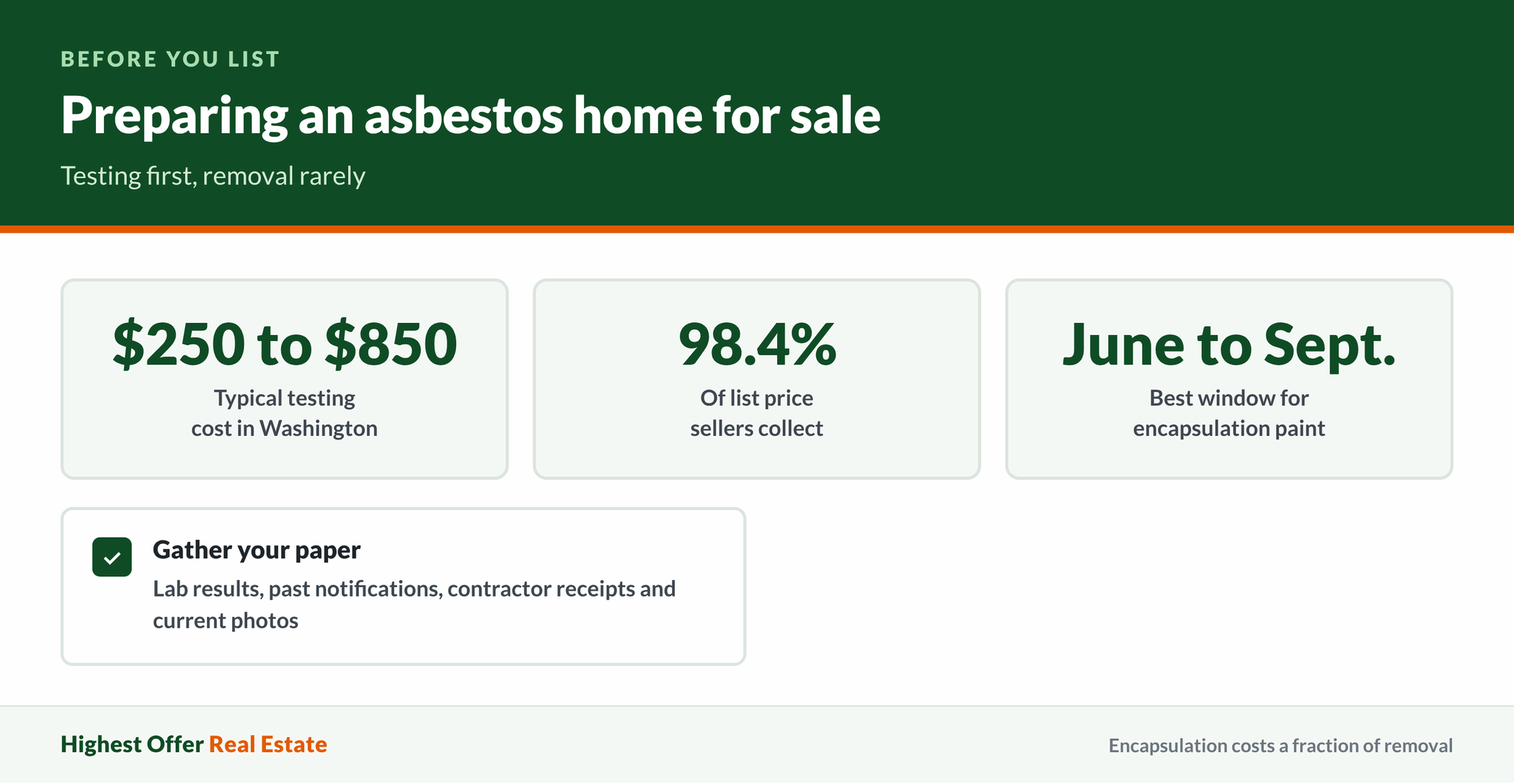
Testing comes first, always. Washington labs typically charge a few hundred dollars for sample analysis, and one published guide puts testing in Washington in the $250 to $850 range depending on scope. That spend buys you a document, and documents end arguments.
Should you abate before listing? My honest read: usually no, unless the material is already damaged or you’re selling to a buyer pool that needs FHA financing on a tight timeline. Full removal on a siding job runs into five figures fast, and you rarely recover it in sale price.
Encapsulation deserves more attention than it gets. Painting intact asbestos siding with quality exterior paint seals fibers in place, costs a fraction of removal, and photographs beautifully. Washington’s wet season does mean you want that work done between June and September.
Gather your paperwork before the listing goes live:
- Lab results with sample locations
- Any past abatement notifications filed with your clean air agency
- Receipts showing who did the work and when
- Photos of the material’s current condition
Pricing is the other lever. With homes across Washington selling at 98.4% of list price on average over the rolling 90-day period as of early October 2026, there’s not much cushion for a surprise. Price the asbestos in at the start and you keep your leverage.
What Should You Do If a Home Inspection Finds Asbestos?
A general home inspector flags suspect material, the buyer’s agent sends a request, and everyone treats the finding as confirmed. It isn’t. General inspectors in Washington aren’t certified to identify asbestos; they note materials that resemble it and recommend testing. That distinction has saved more than one sale I’ve worked on.
Get the sample pulled by someone certified. If the lab comes back negative, you’re done and the buyer has no grounds to renegotiate. If it’s positive, you now have real information instead of a nervous guess in an inspection report.
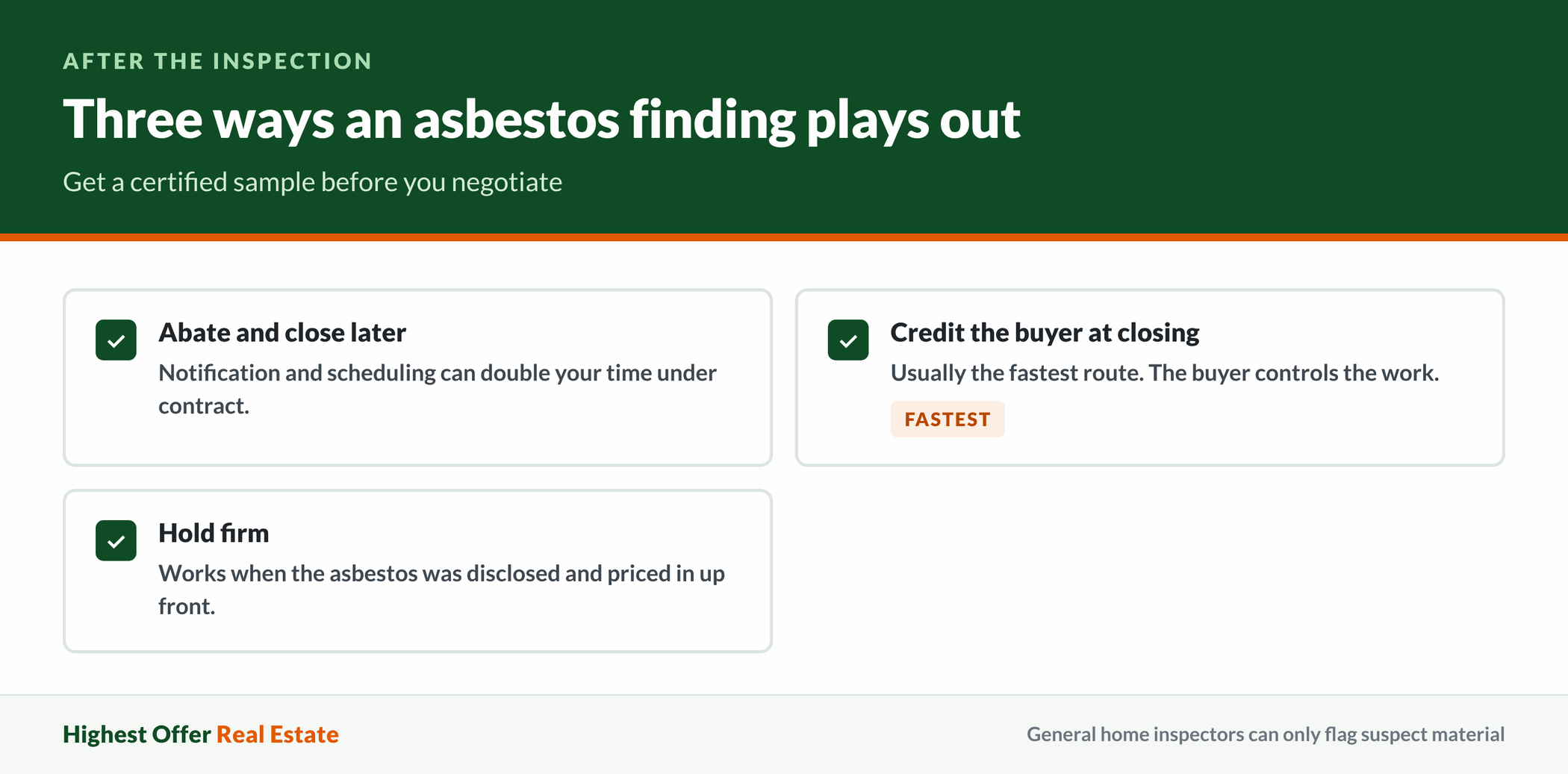
Then comes the negotiation, and there are three realistic outcomes. You abate and close later. You credit the buyer at closing and let them handle it. Or you hold firm, because the asbestos was disclosed up front and already priced into the offer.
Credits move faster than repairs in Washington. A buyer who takes money at closing controls the contractor, the timeline, and the standard of work, and lenders generally accept the structure without drama.
Timing is the pressure you’ll feel most. King County homes were spending a median of 29 days active before selling as of October 2026, and a notification period plus scheduling plus actual abatement can easily double your time under contract. Do you have the runway for that, or does your next move depend on this closing?
Washington buyers using FHA or VA financing face stricter appraisal standards when asbestos material is visibly deteriorated. Intact siding usually passes. Crumbling pipe insulation in the crawlspace often doesn’t, and that’s where sales die.
Will Buyers Walk Away From a House with Asbestos?
“Nobody’s going to touch my house once they hear the word.” I hear that a lot, and the evidence in Washington doesn’t support it.
Thousands of houses with asbestos siding trade hands here every year. Seattle’s October 2026 median sale price was $835,000, and a meaningful share of those closings involved homes built in eras when asbestos was standard residential construction material. Buyers in Wallingford and Queen Anne buy them anyway, because inventory in those neighborhoods is old or nothing.

Which buyers do get skittish? First-timers stretching their budget, buyers with young kids, and anyone whose lender is already nervous. Investors, contractors, and people who’ve renovated before barely blink.
What loses buyers isn’t the asbestos. It’s discovering it late, hearing conflicting information, or watching a seller get defensive about health and safety questions. Transparency early reads as competence. Silence reads as a cover-up, and buyers price fear higher than fact every time.
For sellers who’d rather skip the whole dance, a direct cash sale removes the inspection contingency from the equation. Highest Offer Real Estate buys Washington houses in their current condition, asbestos included, which means no abatement bids and no renegotiation after an inspection report lands.
Who Can Answer Questions About Selling a House with Asbestos in Washington?
Before: a Bremerton homeowner mid-divorce, two attorneys billing hourly, and a 1955 rambler with asbestos tile under the kitchen linoleum. After: a Thursday closing, proceeds split per the decree, and a boat trailer in the driveway that we hauled off ourselves because neither party wanted it.
When removal and notification questions come up, your regional clean air agency is the first call. ORCAA covers Thurston and Mason counties, among others, and publishes homeowner guidance; the Puget Sound agency runs a parallel program for King, Pierce, Snohomish and Kitsap. For worker certification and contractor lookups, Labor and Industries maintains the list of certified Washington abatement firms.
A real estate attorney earns their fee when disclosure gets complicated. Inherited property, undocumented past abatement work, a rental with asbestos in it: those situations deserve thirty minutes with someone licensed in Washington rather than a forum answer.
Your real estate agent should know the asbestos question cold if they work older Washington housing stock. Ask directly how many homes with asbestos they’ve closed. A vague answer tells you to keep interviewing.
Certified inspectors handle the testing, and I’d push back on the common advice to use whoever your agent recommends. Shop two or three. Pricing on sample analysis varies more than it should across Washington, and turnaround time matters when you’re under contract.
Direct buyers are the fourth option, and they’re the right fit for a narrower group than the internet suggests. Your house may need work beyond the asbestos. You may be managing an estate from out of state, or a court deadline may be driving your timeline. Selling as-is clears the whole problem in one transaction.
Frequently Asked Questions
Can You Legally Sell a Home That Contains Asbestos?
Yes, and this is true in Washington and nationwide. The legal obligation sits on telling the buyer what you know, not on stripping the material out first. Fill out your disclosure honestly, hand over any lab reports or abatement paperwork you have, and the sale proceeds like any other.
When Did Builders Stop Putting Asbestos in Washington Houses?
There’s no clean date, which frustrates everyone who asks. Use of asbestos in residential materials dropped off sharply through the late 1970s and early 1980s, but court action kept various products legal afterward. Washington homes built before the mid-1980s are the ones worth testing, though a 1990 build isn’t automatically clear either.
Does Homeowners Insurance Cover Asbestos Tile Removal?
Standard Washington policies almost never pay for routine asbestos removal, because insurers treat it as a maintenance issue rather than sudden damage. Coverage sometimes applies when a covered event, say a burst pipe or a tree through the roof, disturbs asbestos material and forces abatement as part of the repair. Read your policy’s pollution exclusion carefully, or call your agent and ask about that clause specifically.
Do I Have to Test for Asbestos Before Listing My Washington House?
No. Washington’s disclosure law is built around actual knowledge, so a seller who has never tested and genuinely doesn’t know can say so on the form. That said, testing often works in your favor; a negative result removes a buyer objection before it forms, and a positive result lets you control the conversation.
Can a Buyer Sue Me Later Over Asbestos I Didn’t Mention?
They can bring a claim if they can show you knew and stayed quiet. Washington’s disclosure requirement turns on what was in your head at signing, so documenting what you disclosed protects you as much as it informs them. Keep copies of everything you handed over.
Is Asbestos Siding Worth Removing Before I Sell in Washington?
Rarely, in my experience. Intact siding in decent condition sells fine once it’s disclosed, and removal costs usually exceed whatever bump you’d see in price. Deteriorating material is the exception, since damaged asbestos creates both a health question and an appraisal problem.
If you’ve got a Washington house with asbestos and you’re not sure which road makes sense, I’m happy to talk it through. Sometimes the answer is list it with a good agent and disclose well; sometimes it’s an as-is sale that ends the whole thing in a couple of weeks. Reach out to Highest Offer Real Estate when you want a straight read on your options. No pressure, no obligation, and no hard feelings if you decide to go another direction.
Selling a House with Asbestos in Tacoma and Pierce County
Plenty of older homes in Tacoma still wear their original cement siding. We buy them as they stand, with or without a lab report.
Get an As-Is Offer
Contact Highest Offer Real Estate for a written offer on your house, asbestos and all.
You can also fill out the short form below. There’s no cost and no obligation.
Helpful Washington Blog Articles
- How to Sell a House without A Realtor in Washington
- How to Sell a House in Foreclosure in Washington
- Selling a House during Divorce in Washington
- Selling a House With Water Damage in Washington
- Selling Your Washington Home with Code Violations
- Can You Sell a House With Asbestos in Washington
- Who Pays Closing Costs When Selling a House in Washington
- Can You Sell A House With A Lien In Washington
- Selling a House That Needs Repairs in Washington
- Capital Gains Tax on Real Estate in Washington
- How Does Selling a House With a Mortgage Work in Washington
- Selling A House With Solar Panels In Washington
- How To File A Quitclaim Deed In Washington