

A red placard on the front door ends occupancy. It doesn’t end your ownership, and plenty of Washington homeowners get stuck in the space between the two. They keep paying taxes and insurance on a house nobody’s allowed to sleep in while they wait for someone to say what happens next. I’ve bought houses in this exact condition across Washington, from Spokane Valley to the edge of Grays Harbor County. A condemned house still has a legal owner, a recordable deed, and a market. It’s a smaller market, sure, and a real one.
What Is a Condemned House in Washington?
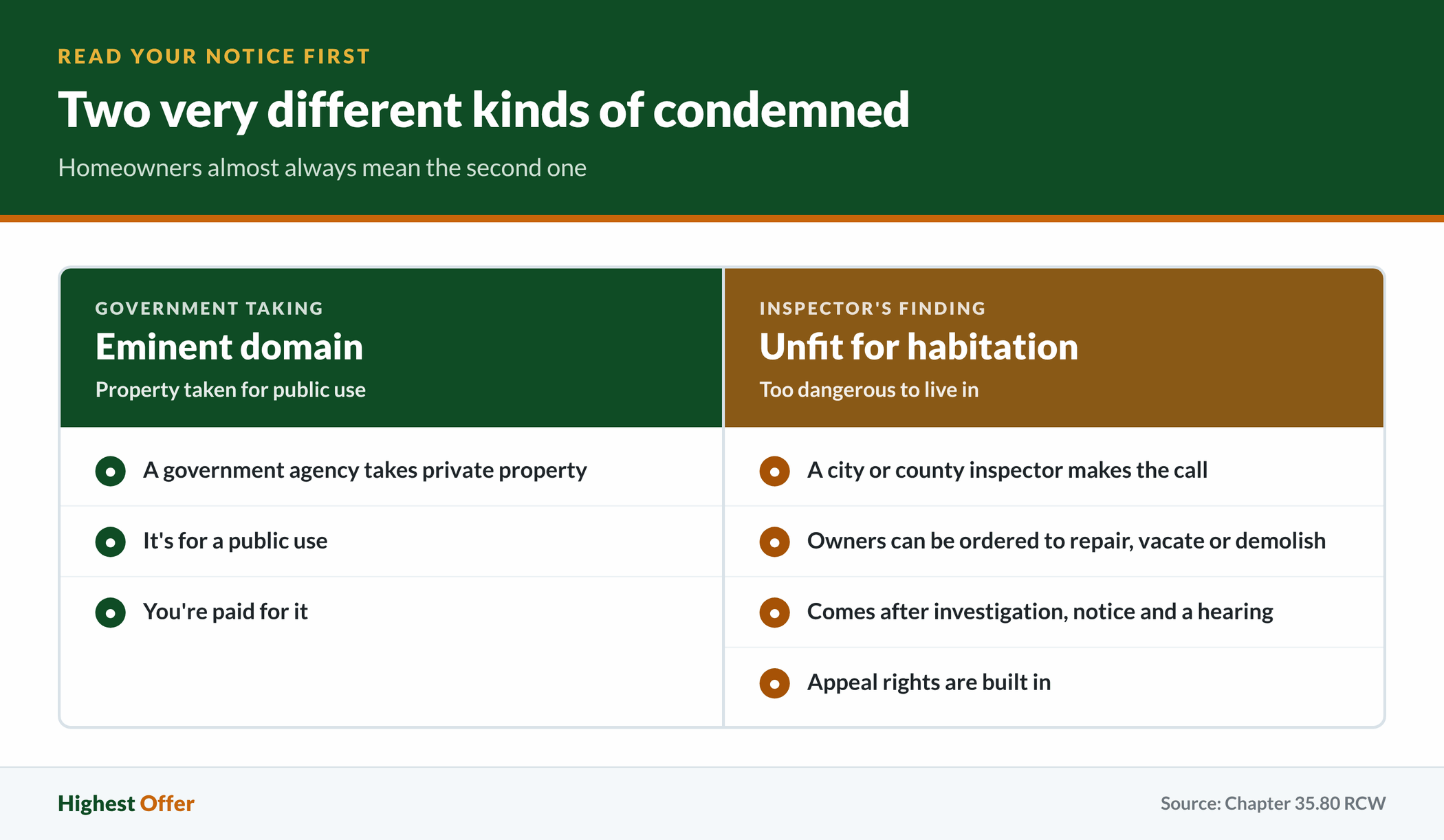
Few words in Washington real estate get misused as often as “condemned,” and the mix-up costs sellers money.
Two separate legal processes share that label. Eminent domain is one, where a government agency takes private property for public use and pays you for it. The other is a habitability finding, where a city or county inspector decides a structure is too dangerous to live in. When homeowners say they’ve got a condemned house, they almost always mean the second one.
Washington’s rules for that second kind sit in state law on unfit dwellings. Cities and counties can set up improvement boards or officers to look into dangerous structures. After an investigation, notice, and a hearing, they can order owners to repair, vacate, or demolish a building found unfit for habitation, and owners keep their appeal rights. The Washington State Legislature’s site has the full chapter if you want to read it yourself.
A county, city, or town in Washington can also condemn “blighted” property, and that takes at least two qualifying factors. An inspector might point to a building that hasn’t been lawfully occupied for a year or more. Another factor is the local executive authority deciding it threatens public health, safety, or welfare.
Pull out your notice and read the heading. A hazard correction order, an emergency order to vacate, and a formal unfit finding each carry different timelines and different consequences.
Why Do Houses Get Condemned in Washington?
Older houses in Everett show how it happens. One 1940s rental had a slow roof leak nobody chased for six winters. By the time the tenant moved out, the second-floor joists were spongy, and the inspector tagged the whole structure.
Water does most of the damage in western Washington. Our rain is relentless more than dramatic, and a failed flashing detail on a Ballard bungalow will quietly rot a wall cavity for years. Mild temperatures keep mold growing straight through January. East of the Cascades, it’s frozen pipes in Moses Lake, foundation movement in silty soil, and wildfire damage in Chelan County.
Structural failure, fire, sewer and septic failure, and meth contamination are the other common routes to condemnation. Seattle charges owners of monitored vacant buildings between $271.85 and $542.60 per month depending on condition, so an empty house can bleed money long before anyone declares it unfit.
Early last year I bought a house in Lakewood from a longtime landlord who was three months behind on his mortgage, with an auction date already set. His tenant had moved out, leaving behind a condemned property with car parts filling the garage and a kitchen floor that gave underfoot. We closed on a Thursday before the trustee sale, and he walked away with equity instead of a foreclosure on his record.
Most of the time it’s a cash flow problem that outlasted the owner’s patience. That’s why it so often falls on someone already handling an illness, a job loss, or a death in the family.
What Happens When a House Becomes Condemned?
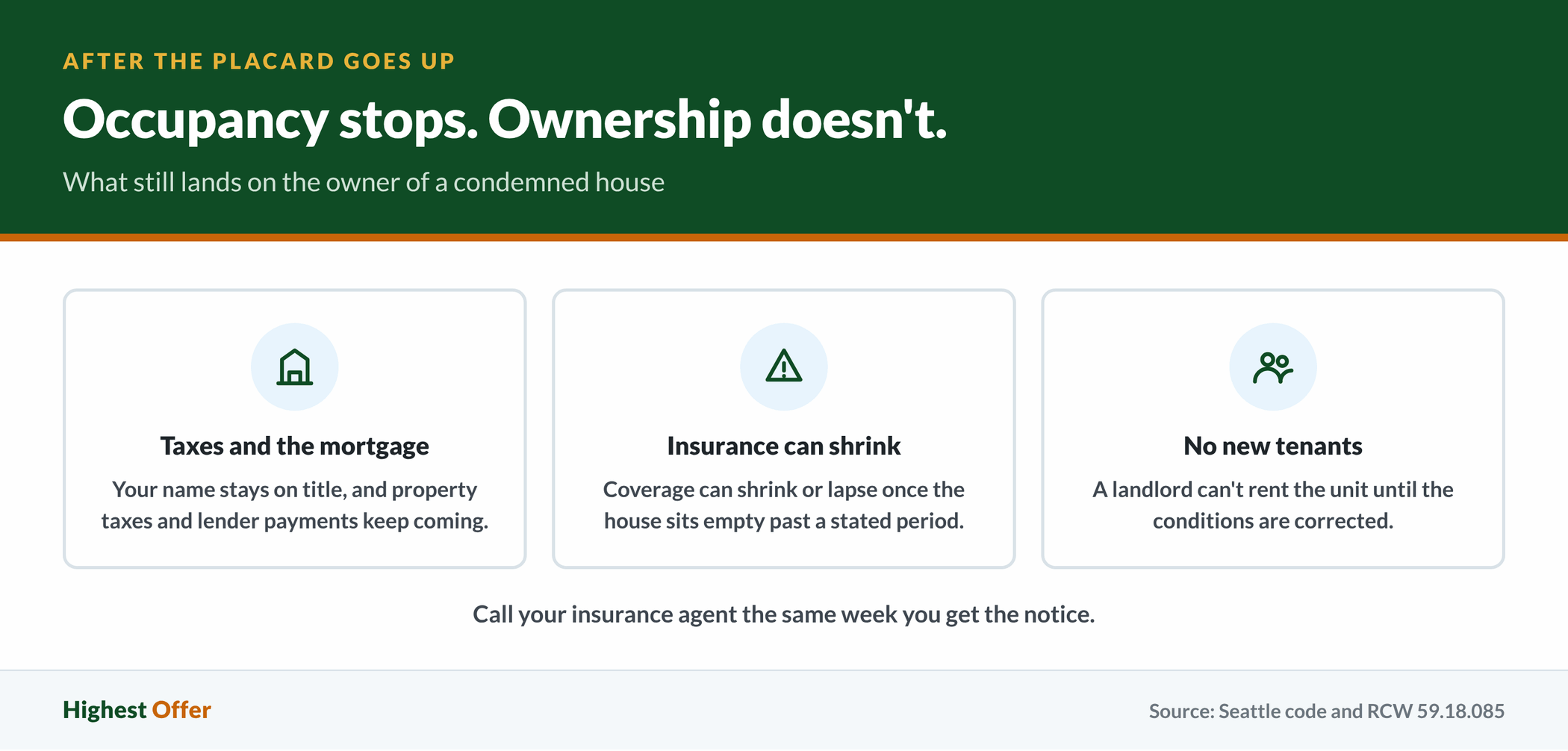
The answer depends on which order you got. Seattle’s building code lets the building official issue an emergency order when a structure poses an imminent hazard to life or limb. That order can require the building be restored to a safe condition by a set date, or vacated within a reasonable time the order specifies. In extreme danger, it can demand that everyone leave immediately. Other Washington jurisdictions run similar processes under their own municipal codes.
Occupancy stops. Ownership doesn’t. Your name stays on title and your property tax bills keep arriving. Your lender still expects payments on a home nobody can legally live in.
Insurance gets messy fast. Most carriers treat a vacated structure differently from an occupied one, and coverage can shrink or lapse once the house sits empty past a stated period. Call your agent the same week the notice arrives. I’ve watched sellers lose a fire claim because the policy had quietly turned into something much thinner.
Renting the place out adds another layer, because Washington takes tenant protections seriously. Once a code enforcement agency tells a landlord a dwelling is condemned or unlawful to occupy, the landlord can’t sign a rental agreement for that unit until the conditions are corrected. Relocation assistance duties can attach too, with narrow exceptions. The relevant statute spells out the remedies and penalties.
Code officers in Washington generally want the property fixed or sold to someone who will fix it. Demolition is the tool they reach for last.
How Do You Remove a Condemned Status in Washington?
In most of Washington, getting back to habitable status follows a familiar pattern. You address every item listed in the order and pull permits for the work that needs them. Then you schedule inspections as each phase closes and ask the same department that issued the finding for a final determination. Your local building department sets the specifics, so they vary by jurisdiction. Call the office named on your notice and ask exactly what its compliance path looks like.
Seattle’s standard shows why. The city can order demolition when there’s a documented extreme hazard, or when repair would cost more than half of what replacement would cost. Its page on unfit buildings lays out the whole process.
Do the arithmetic before you commit. A condemned home that needs foundation work, a new roof, full rewiring, and mold remediation can easily swallow $150,000 in Washington labor and materials. That’s before you find out what’s behind the next wall.
Deadlines are short and they’re printed on your notice. Read them twice.
Owners start repairs without permits to save money, get caught, and end up with a stop work order on top of the original problem. That detour adds months to a condemned house timeline and makes the eventual sale harder.
What Are Your Options for a Condemned Property?
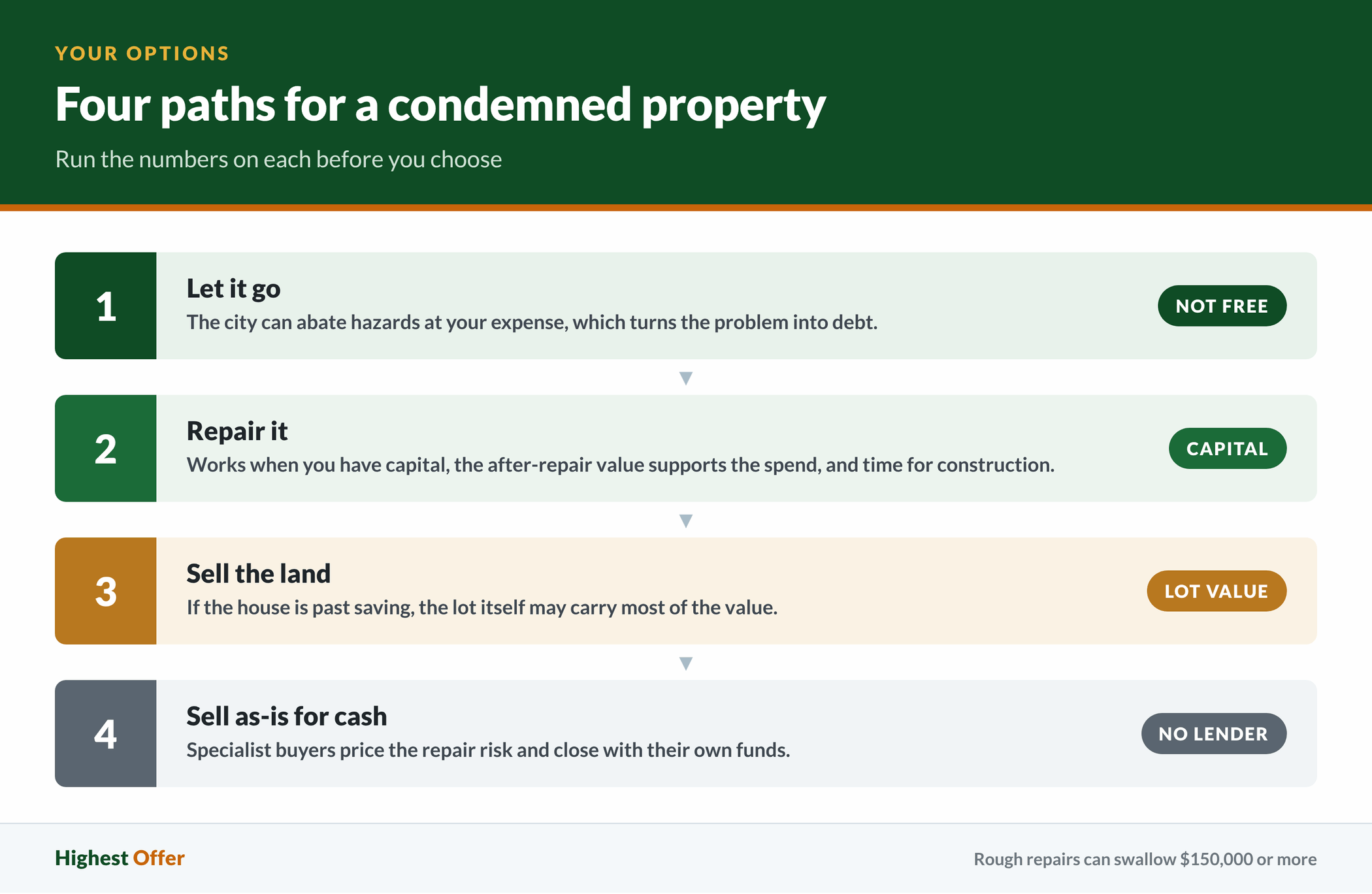
Most owners sketch the same short menu on the back of an envelope. The first option on it bites harder than people expect.
Letting it go isn’t free. When a property endangers the public, Seattle’s department can seek an abatement order, a court order that lets the city enter the property and cure violations at the owner’s expense. Walking away from a condemned house in Washington doesn’t end the obligation. It just converts it into debt.
Repairing works when three things line up. You need access to capital, an after-repair value that supports the spend, and the patience for a construction timeline. In King County, where the median sold price sat at $838,990 in October 2026, that math works far more often than it does in rural Klickitat County.
Selling the land gets overlooked. If a condemned house in a Tacoma or Vancouver neighborhood is truly past saving, the lot itself may carry most of the value. That’s especially true for a buildable parcel near transit, or in an area zoned for middle housing, where builders tend to show up first.
Even then, the numbers rarely pencil out without permits and environmental review.
Then there’s selling as-is to someone who buys condemned properties on purpose. Investors who specialize in this work price the repair risk, close with their own funds, and don’t need a lender’s blessing. Local buyers like Highest Offer Real Estate handle condemned house situations across Washington regularly. That matters, because an out-of-state wholesaler won’t understand Snohomish County permitting or what a King County demolition estimate looks like in practice.
Can You Sell a Condemned House in Washington?
Thirty-four days was the median time on market for Washington homes as of October 2026, when the statewide median price was $587,538, down 2.1% from a year earlier. A condemned house won’t follow that curve. The figure still tells you something useful: this isn’t a frenzied market where anything sells itself. Condition matters more now than it did three years ago.
Yes, you can sell. No Washington statute bars transferring title to a condemned house. What changes is who’s in the buyer pool.
Lenders need a property to meet minimum habitability standards for the appraisal. A condemned house fails that test on sight, which rules out FHA and VA loans too. Your realistic buyers are cash investors, builders buying for the lot, and the occasional owner-occupant with a renovation loan and a real appetite for risk.
Washington’s disclosure statute makes Form 17 mandatory for virtually every residential sale. Selling as-is doesn’t exempt you from completing it or from disclosing known material defects. Sellers deliver the completed form to the buyer within five business days of mutual acceptance, and the full chapter is in the state’s RCW database.
A serious buyer of a condemned house wants that paperwork, since it tells them what they’re underwriting. Hiding it is how sales fall apart in escrow.
Expect a lower price, of course. A condemned house in Washington sells at land value plus some salvage, minus the demolition or rehab the buyer inherits.
How Do You Sell a Condemned House As-Is?
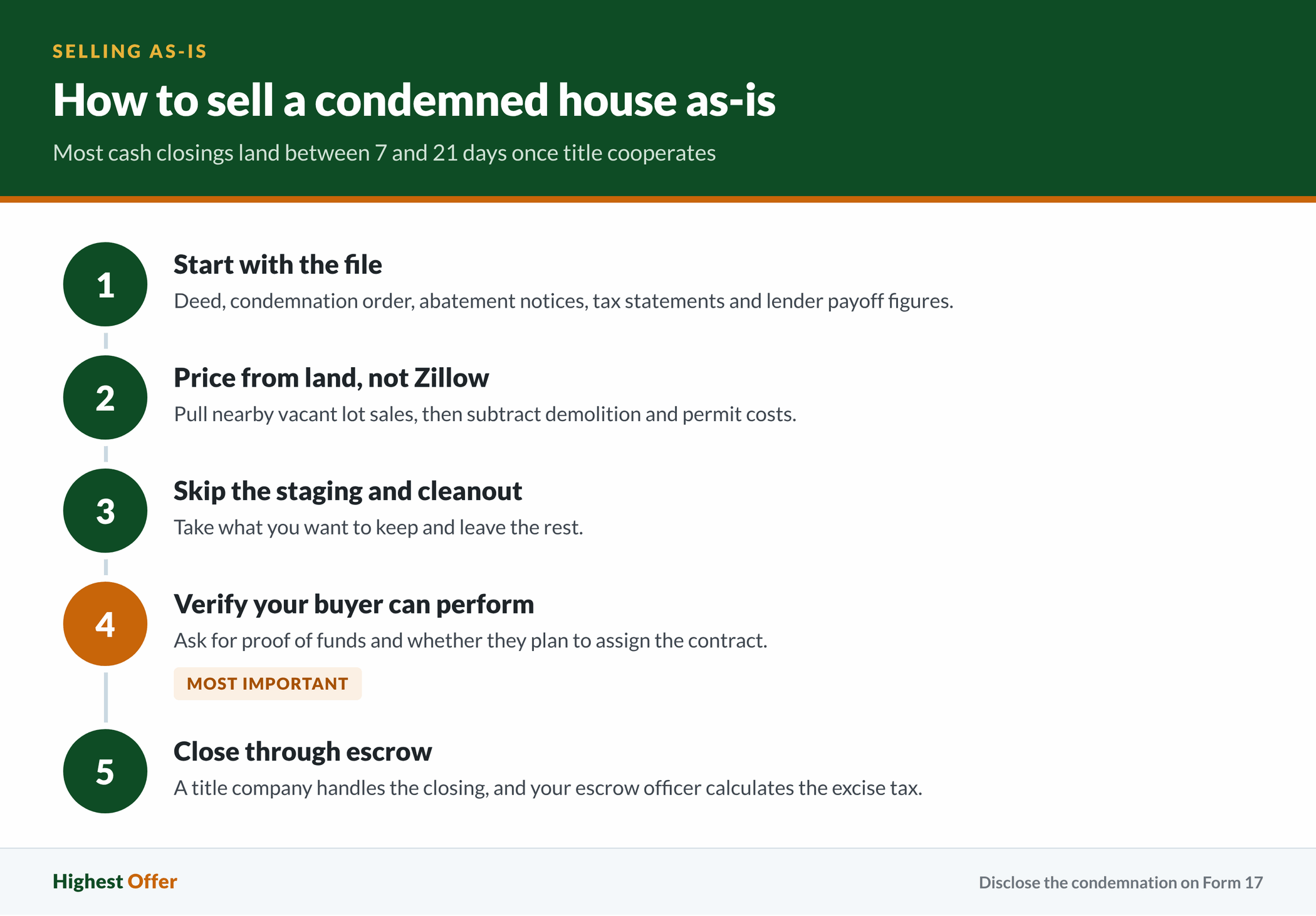
Underestimate the repair risk in your head and you’ll turn down a fair offer, sit on the house another eight months, then take less once carrying costs eat the difference. I’ve watched that happen more than once.
Start with the file. Gather your deed, the condemnation order, any abatement notices, property tax statements, and payoff figures from every lender or lienholder. Title problems come up constantly on a condemned house in Washington, from old judgments and unreleased mortgages to probate issues when the owner has died.
Price from land, not from Zillow. An automated valuation has no idea your floor joists failed. Pull vacant lot sales in your neighborhood and subtract demolition and permit costs for an honest starting range.
Don’t bother staging. Skip the cleanout too, unless there’s something inside you want to keep.
Make sure your buyer can perform. Ask for proof of funds, how many condemned properties they’ve closed in Washington, and whether they plan to assign the contract. A wholesaler who ties up your house and shops it around for sixty days is the worst outcome you can get.
Washington closings run through escrow, and the excise tax applies like any other transfer. Your escrow officer calculates it, since rates vary by location and sale price. You’ll likely net less than a cosmetic fixer would bring, though more than most sellers fear.
Listing can work if the lot sits in a hot submarket and you can wait. On a low-value condemned house, the commission often isn’t worth the months.
How Quickly Can I Sell My Condemned House in Washington?
A woman in Port Orchard called about her father’s place after he moved into assisted living. The county had tagged the house after a sewer line failure flooded the crawlspace. The garage held forty years of fishing gear and a boat that hadn’t touched water since the nineties.
Her title was clean and she held power of attorney. She took three boxes of photographs and left the rest.
That’s the realistic ceiling on speed for a condemned house in Washington when the paperwork cooperates. Most cash closings land between seven and twenty-one days, and title work drives that timing more than the building’s condition.
Probate without an appointed personal representative adds months. So does a reverse mortgage or an unpaid contractor’s lien, since escrow can’t disburse until those clear.
A listing is slower. Financing, appraisal, and inspections would stack up well past a month, and most lenders would decline the file once the condition came up.
Order a title report early, find the deed, and confirm who can legally sign. If a parent is living but can’t manage their affairs, sort out power of attorney or guardianship before you take offers.
If the city has set a compliance deadline, tell your buyer the date. Teams like Highest Offer Real Estate work backward from it and often ask code enforcement for a short extension while the sale closes. A signed purchase agreement carries real weight with a code officer who’d rather see the problem fixed than demolish the structure.
Frequently Asked Questions
Does a Condemned House in Washington Still Owe Property Taxes?
Yes. Your county treasurer keeps billing even after a building is declared unfit. The assessed value may drop, though rarely to zero, because the land keeps its value. Delinquent taxes turn into a lien that has to clear at closing, so contact your county treasurer’s office for current balances and any payment arrangements they offer.
Do I Have to Tell Buyers About the Condemnation?
Yes. Washington’s mandatory seller disclosure form requires it, whether or not you’re selling as-is. Hiding a known material defect exposes you to liability after closing, which is far worse than a lower price. Hand buyers the notices and reports up front, since experienced buyers of distressed property expect them.
Is It Worth Repairing Before Selling?
Only if you have the money, the time, and an after-repair value that clearly beats your total spend plus carrying costs. Partial repairs are usually the worst choice, because you spend real money without lifting the property into financeable condition. Get two contractor estimates and compare the total with a cash offer before you decide.
What If I Owe More Than the House Is Worth?
That happens a lot with condemned property, and you still have options. A short sale is possible with lender cooperation, and some buyers will negotiate directly with your lienholders as part of buying the house. Start with an exact payoff figure, because the gap is often smaller than owners imagine.
Get a Straight Answer on Your Condemned House
If you’ve got a condemned house in Washington and can’t tell which direction makes sense, reach out to us, a Washington cash buyer, and we can go through the numbers together. Whether you repair, list, or sell as-is, you’ll at least know what each path really costs. There’s no pressure, no obligation, and no hard feelings if you decide to keep the place and fix it yourself.
You can reach out to Highest Offer Real Estate and tell us what your notice says. Together we’ll compare the repair, the land, and the as-is option. If that’s easier, fill out the short form below and we’ll follow up with a cash offer to weigh against your other choices.