
A screwdriver and a flashlight are all it takes to end a sale. A buyer’s inspector carried both into a crawl space in Tacoma, and ninety seconds later the whole transaction was in question. If you own a house in Washington and suspect termites are chewing on your framing, you aren’t stuck. You’ve got more paths forward than your agent probably laid out.
What Are Termites and How Do They Damage Washington Homes?
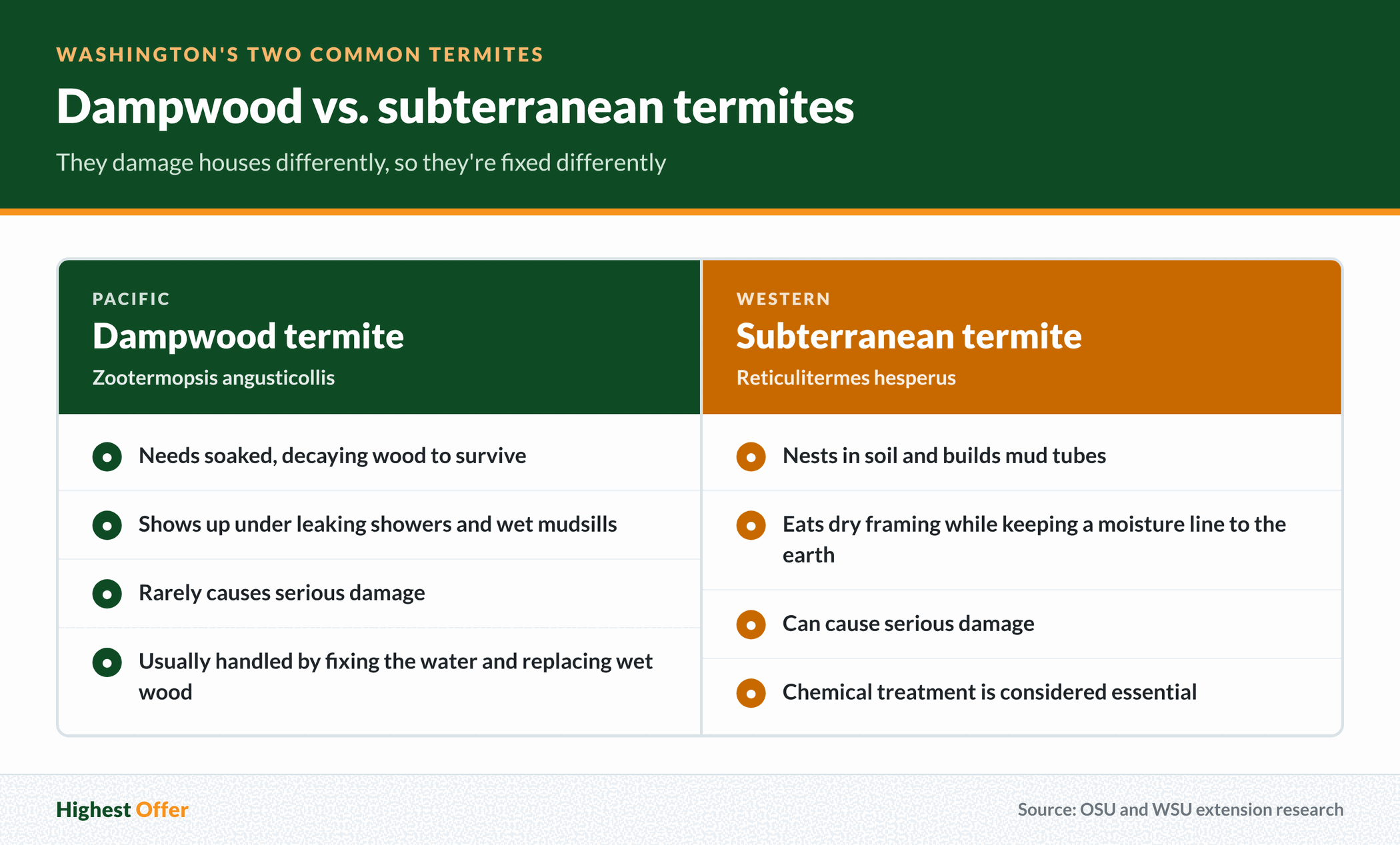
Two species do nearly all the damage in this state. Washington really only has two common termites, the Pacific dampwood termite, Zootermopsis angusticollis, and the western subterranean termite, Reticulitermes hesperus, according to extension research shared through Oregon State’s wood products program.
Dampwood termites follow water. They can’t survive without soaked, decaying wood, so they settle into rim joists under a leaking shower, mudsills touching wet soil and the bottom of a porch post. WSU’s structural pest program describes dampwood termites as infesting very wet wood while rarely causing serious damage.
Western subterranean termites behave differently. They nest in soil, run mud tubes up your foundation wall and eat perfectly dry framing while keeping a moisture line back to the earth. The WSU Subterranean Termite Mapping Project notes these termites infest dry or damp wood and can cause serious damage. Its mapping work found them concentrated in loamy soils instead of clay or rocky ground.
Your address matters. On the west side, subterranean termites range only as far north as Seattle, and dampwood termites have limited distribution in eastern Washington.
Damage in Washington homes almost always starts low, in crawl spaces, footings, subfloors and the framing of daylight basements. By the time termites reach visible interior walls, they’ve been working underneath you for a long while.
How Can You Tell If Your Washington Home Has Termites?
For years I told sellers that visible mud tubes meant an active problem and no tubes meant they were fine. I was wrong on both counts.
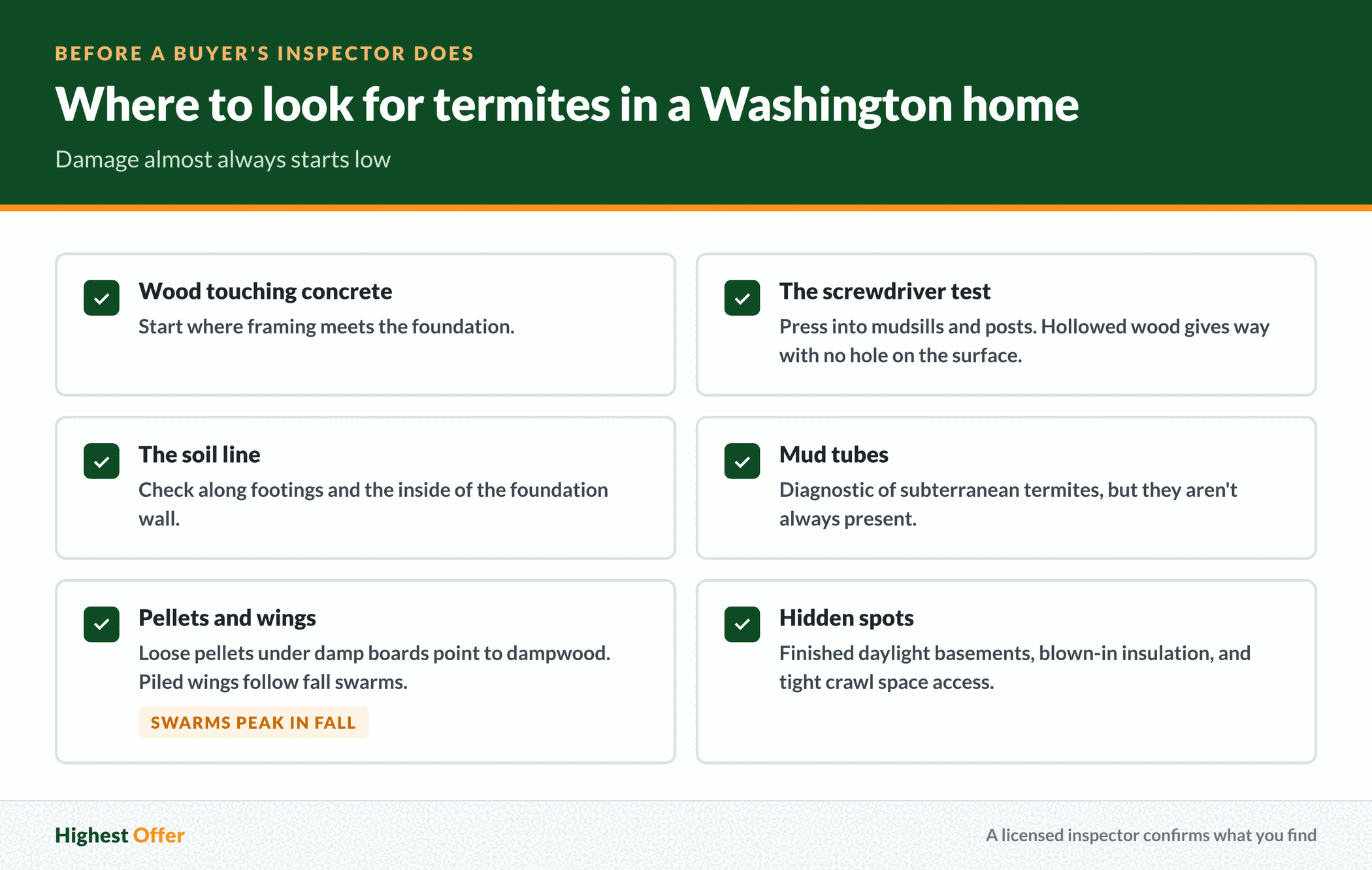
Extension guidance is blunt on this point: tubes are diagnostic of subterranean termites, but they aren’t always present.
So what should you actually check in a Washington crawl space? Start with any wood that touches concrete, and press a screwdriver into mudsills and posts. Wood hollowed from the inside gives way with no hole showing on the surface. After that, look at the soil line along footings and the inside of the foundation wall.
Dampwood termites leave loose scatterings of fecal pellets under soft, damp boards. Subterranean termites pack theirs into tubes and galleries.
Swarms are the loudest signal you’ll get. Termite swarming in Washington happens mostly in the fall, so homeowners around the Puget lowlands and in Yakima tend to call pest control in September instead of spring. Wings piled on a windowsill after a warm, wet evening are worth a call.
Last year I bought a house in Puyallup from two adult children whose mother had moved into assisted living. One of them had a job transfer and five weeks to be out. On a Saturday walkthrough we found old subterranean termites damage in the rim joists, tucked behind a wall of garden tools in the garage. Nobody had any idea it was there.
Termites hide well in Washington homes. Finished daylight basements, blown-in insulation and tight crawl space access all work against a casual look.
Do You Have an Active Termite Infestation or Just Past Damage?
Price a house as though termites are still eating it when the colony died out a decade ago, and you’ve handed a buyer tens of thousands of dollars for nothing. The opposite mistake costs more. Sell it as “old damage” while a live colony is working, and you’ve created a disclosure problem you can’t unwind.
So how do you tell the difference before you sell? A licensed inspector can, and in Washington that’s a specific credential.
Under Washington law, inspecting for pests, their signs or conducive conditions requires a license from the Washington State Department of Agriculture. Every wood destroying organism report prepared for a transfer, exchange or refinance has to carry an Inspection Control Number, and the WSDA structural pest inspector page spells out who qualifies. A general home inspection doesn’t become a complete WDO inspection just because the inspector mentions pests in the report.
Damaged wood with no live organism in it is just damaged wood. That makes it a structural repair question instead of a pest question, and buyers price the two very differently.
One pattern keeps showing up. Sellers treat for termites and then can’t produce the paperwork. In Washington, a four-year-old treatment receipt with a warranty attached is worth real money at the negotiating table, while a verbal “we had a guy out” is worth nothing. Dig through the filing cabinet before you list.
If your termites turn out to be dampwood, the conversation shifts almost entirely to moisture. WSU’s position is that dampwood termites are generally handled by fixing the water problem and replacing the wet wood, and pesticides are rarely needed.
Who Pays for the Termite Inspection When You Sell a House in Washington?
Whoever pays the least attention to timing usually ends up paying the most money. I’ve seen sales fall apart over exactly this, and it’s why sellers should pay for their own inspection before the sign goes in the yard. Plenty of agents in Washington will tell you to wait, and I’ll argue that one with them.
Washington custom puts the WDO inspection on the buyer, usually bundled into their inspection contingency. That custom doesn’t serve you. A buyer’s inspector works for the buyer, writes the report in the buyer’s language and hands you a repair demand right when your leverage is lowest.
Pay a licensed structural pest inspector yourself and you control the sequence. You’ll know whether termites are active before a buyer’s earnest money is at stake, instead of scrambling to react to someone else’s clock. You’ll also get quotes from repairmen on your own timeline, not a seven-day one.
Inspection cost runs modest compared to what termites could cost you. A complete WDO inspection on a typical Washington house costs a few hundred dollars, with prices moving around based on square footage and crawl space access.
The market numbers matter here. Statewide, homes were selling in a median of 29 days with a 98.4% sale-to-list ratio as of early October 2026. The market was balanced, with four months of inventory, per Beyond Real Estate’s Washington market report. In a balanced market, buyers in Washington have options, and they’ll walk over a termites surprise.
A seller holding a current report with an ICN on it walks into negotiations as the person with information instead of the person receiving it.
Buyers using FHA or VA financing in Washington often need a WDO report anyway, so somebody’s paying for one. Deciding early that it’s you is the cheaper version.
Do You Have to Disclose Termite Damage When Selling in Washington?
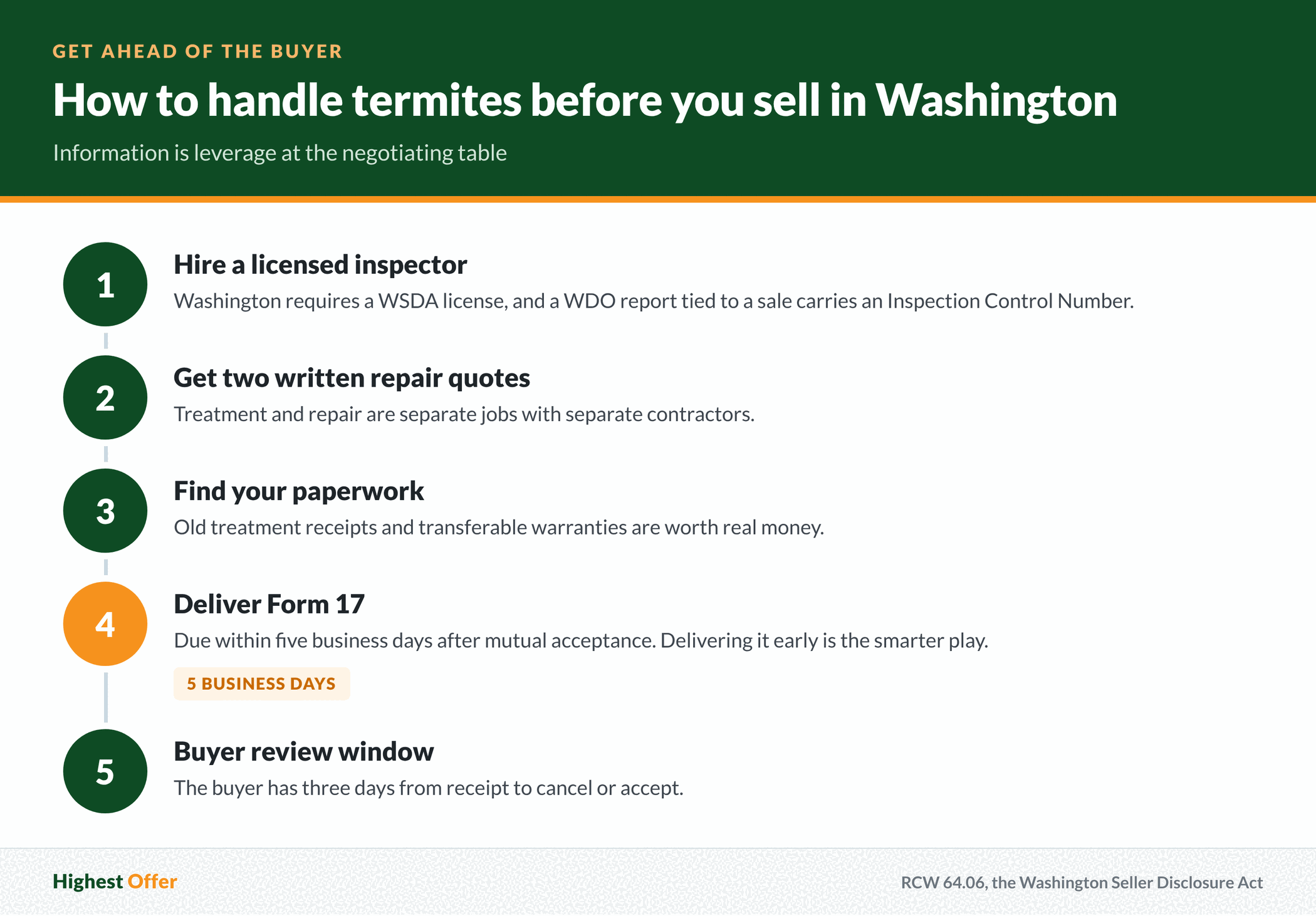
I get that question more than any other, and in Washington the answer is firm. The Washington Seller Disclosure Act, RCW 64.06, requires most sellers to complete and deliver a Seller Disclosure Statement, known as Form 17. The whole chapter is on the Washington State Legislature site.
Disclosure runs on what you know. You answer Form 17 from your actual knowledge, covering structure, systems, environmental conditions and more.
The window is tight. Washington law gives the seller five business days after mutual acceptance to deliver the statement, and the buyer then has three business days from receipt to cancel or accept. I’d deliver it early in Washington, before anyone signs, because it moves the termites conversation to the front of the sale where it costs you the least.
Some transfers in Washington are exempt from Form 17. RCW 64.06.010 lists the exceptions, and a real estate attorney can tell you in one phone call whether yours qualifies.
Washington protects honest sellers. Under RCW 64.06.050, a seller isn’t liable for an error or omission in the disclosure statement when the seller had no actual knowledge of it.
Write down what you know about the termites and say it plainly. Vague wording invites buyers to imagine something worse than the truth.
What Are Your Options If Your Washington Home Has Termites?

Most articles skip the fact that termites treatment and termites repair are two separate jobs with two separate contractors. Sellers routinely pay for one and assume it covered the other.
Option one is to treat, repair and then list. Chemical treatment is considered essential for subterranean termites, and bait stations are a common approach for ongoing control. You rebuild the damaged framing, keep every receipt and market the house as remediated.
Two: list with the termites disclosed and let the price absorb it.
Option three is selling directly to a buyer who prices crawl space damage for a living and closes without a lender’s repair conditions attached. That’s the lane we work in at Highest Offer, and it’s the right answer for maybe a third of the Washington sellers who call us.
Repair money has to come from somewhere, and a termites rebuild in a crawl space means labor-heavy work on an awkward schedule.
Regional swings matter too. A Spokane rim joist replacement and a Bellevue one won’t be the same invoice, even for the same linear footage.
Prevention pays off on any house you keep. Pull wood debris away from footings, fix the gutter dumping water against your foundation and keep soil below the siding. Those moves make Washington houses unattractive to termites and cost almost nothing.
Washington buyers inspect, and they almost always find termites if they’re there.
Can You Sell a House with Termite Damage As-is in Washington?
A landlord in Spokane Valley called me about a rental with a sagging kitchen floor. His tenant moved out on a Friday, and by Monday afternoon the pest inspector had found subterranean termites in the subfloor.
Yes, you can sell as-is in Washington, with one correction to the phrase. As-is governs repairs, not disclosure. You still complete Form 17 honestly and simply decline to fix what the report finds.
Conventional buyers in Washington can and do buy houses with termites damage, though their lenders tend to complicate things. An appraiser who notes active infestation or structural compromise can condition the loan on repair, and suddenly your as-is sale has repairs in it anyway.
What as-is really costs you is predictable. Buyers discount for uncertainty, and they always price uncertainty higher than the actual repair. I’ve seen a $9,000 crawl space rebuild turn into a $20,000 offer reduction because the buyer was pricing the worst case they could imagine.
That gap is the reason to get the inspection and the contractor bid in hand before you market the house. Give a Washington buyer a licensed inspector’s report and two written quotes, and the imagination shuts off. You’re negotiating over a real number at that point.
Marketing matters too. Put photographs of the repaired areas, the WDO report with its control number and the treatment warranty paperwork in the listing packet instead of waiting for the buyer’s inspector to “discover” termites.
Washington’s balanced conditions right now give sellers room to do this properly. A termites disclosure up front doesn’t kill a sale the way a mid-escrow surprise does.
What Will Buyers Offer for a Washington House with Termites?
Sitting at your kitchen table, I’d tell you this: the first number any buyer gives you on a house with termites is a flinch, not an offer.
Once documentation exists, the number moves. I’ve watched offers climb by five figures between the first conversation and the second. The only thing that changed was a seller producing a WDO report showing the colony was dead and the damage stopped at four feet of mudsill.
Retail buyers in Washington usually subtract the repair bid plus a cushion for disruption. Investors subtract the repair bid, their holding costs and their margin.
Location drives the termites discount more than most sellers expect. King County’s median sold price sat at $838,990 in the October 2026 county data, with 28 median days on market. Against a Bellevue or Kirkland sale price, a $15,000 termites repair reads as a rounding error. Clark County’s median was $509,900 in that same October 2026 report, published in Beyond Real Estate’s county comparison, and there the same repair takes a bigger bite.
Dampwood termites findings usually cost you less at the table than subterranean termites findings, and that’s fair.
An heir in Olympia reached out after nearly a year of paying two mortgages, one on her own home and one on her late father’s house. His house had termites in the daylight basement framing, and a 1978 Ford pickup sat in the garage that she couldn’t bring herself to sell. We closed in under three weeks. She told me later the relief wasn’t the money. It was the Tuesday she stopped writing the second check.
If you want a straight read on what your Washington house is worth with the termites damage priced in, the Highest Offer team will walk the crawl space and tell you.
Frequently Asked Questions
Are Termites Really a Problem in Washington State?
They are, though not the way Gulf Coast homeowners experience them. Washington has two native species, and only one does structural harm at any scale. Houses on loamy soil, houses with chronic crawl space moisture and houses where wood meets dirt are the ones that see trouble. Plenty of Washington homes go a century without a single termite.
Am I Legally Required to Tell a Buyer About Termites?
Yes, if you know about them. Washington’s seller disclosure statute requires you to report material facts about the property’s condition based on what you actually know, and termites damage clearly qualifies. You aren’t required to guess, and the statute protects sellers who genuinely didn’t know. People get into trouble when they write “don’t know” and they do.
Is It Difficult to Sell a Washington House That Termites Have Damaged?
It’s harder than selling a clean house and easier than most sellers fear. The difficulty scales with the documentation you bring. A house with an unexplained soft spot in the floor scares everyone away. That same house with a licensed inspector’s report, a treatment warranty and a contractor’s written bid draws normal offers at an adjusted price. Your buyer pool shrinks a bit because some lenders balk, while cash buyers and renovation-minded buyers stay interested.
Should I Treat for Termites Before Listing or Let the Buyer Handle It?
Treat first if you can afford it and have the weeks to spare. A finished treatment with transferable warranty paperwork reads as a solved problem. An untreated active infestation reads as an open-ended liability, and buyers price those brutally. If cash or time is short, get the inspection anyway so you at least know what you’re disclosing.
Will a Mortgage Lender Refuse a House with Termite Damage in Washington?
Refusal is rare, and conditions are common. Government-backed loans in particular tend to require a clear wood destroying organism report, and an appraiser who notes active termites or compromised framing can trigger a repair requirement before funding. That’s exactly why sellers with real damage often end up at a cash closing, where no lender is in the room making demands.
How Fast Can I Sell a Washington House with Termites for Cash?
Direct sales to a local buyer generally close in two to four weeks in Washington, termites and all, and title work sets most of that pace. You won’t face repairs, staging or an inspection contingency. The tradeoff is price, since you’re giving up some dollars for speed and certainty, and that trade suits some sellers and not others.
If you’re staring at a crawl space full of bad news and can’t tell which direction makes sense, give us a shout and we’ll talk it through. We’ll tell you honestly if listing with an agent would net you more, even when that means we don’t buy your house. There’s no pressure, no obligation and no sales pitch waiting on the other end of the call.
Termite Damage and Home Sales in Tacoma
Tacoma has plenty of older homes with crawl spaces sitting close to wet soil. RexMont put the city’s median listing price near $619,000 in September 2026, and at that price a documented repair bid gives buyers a real number to work with.
If you’re outside the city, you can see how we buy houses in Washington with termite damage already priced in.
Talk With Us About Your Termite Situation
Send us what you know, even if it’s only a soft spot in the floor and a hunch, and we’ll tell you whether repairs, a listing or a direct sale makes the most sense. Reach out to Highest Offer or fill out the form below.