

A homeowner in Tacoma called me last spring sure her place would be gone in a weekend. Her neighbor’s split-level had sold in nine days back in 2021, and that number had stuck in her head. Five years on, the math looks different. If you want to sell a house in Washington right now, the honest answer is weeks of market time plus another month of escrow. Most of the frustration lives in the gap between those two numbers.
I’ve bought houses from Bellingham down to Vancouver, and the timeline question comes up in every single conversation. It deserves a straight answer.
What Is My Washington Home Worth?
Overprice a listing by eight percent and you don’t sell slower; you sell for less. That’s the part that stings. Serious buyers see your property in its first two weeks on market. If your number scares them off, you’ll spend the next two months chasing the price down while the listing goes stale.
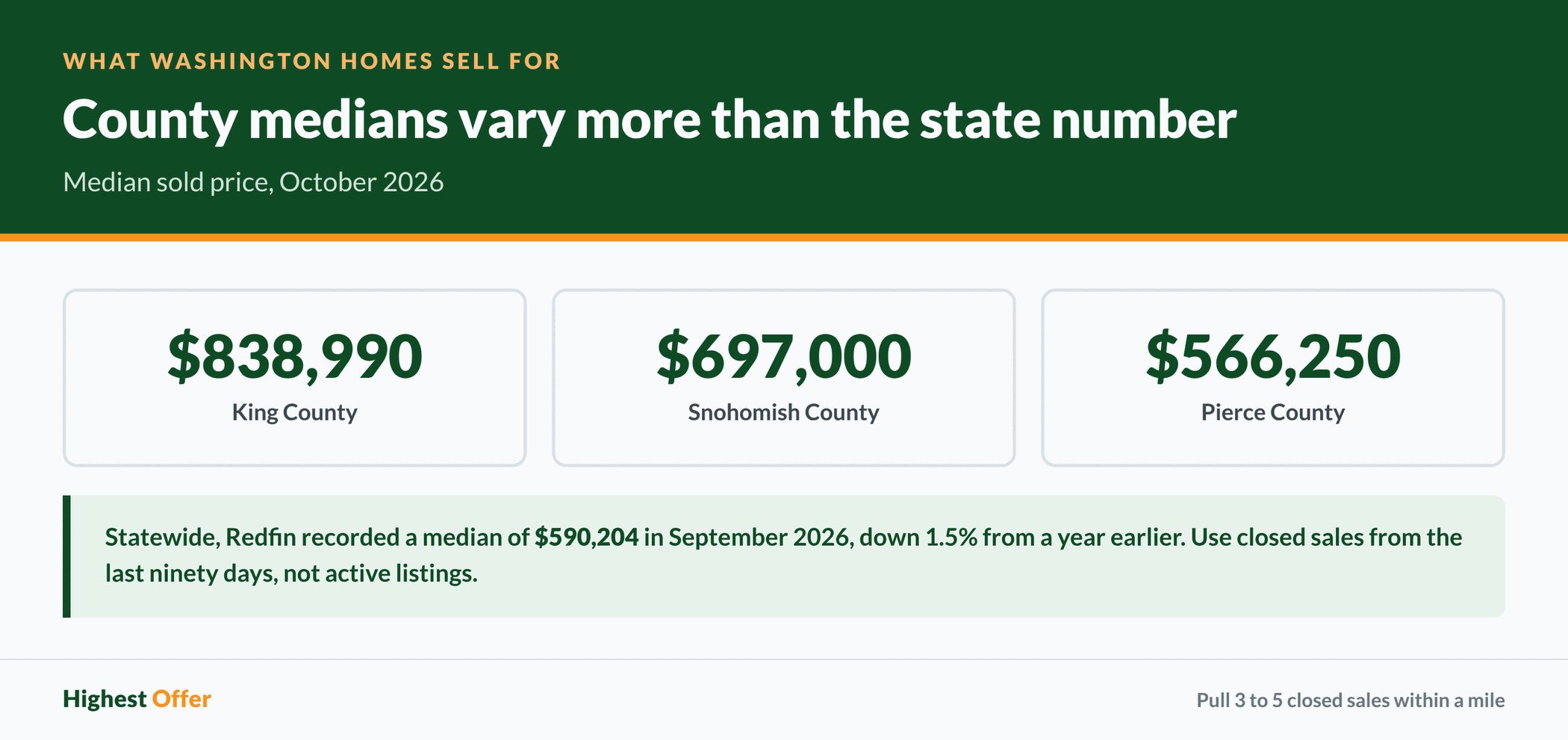
Statewide numbers give you a starting point when you sell a house here. Redfin recorded a median price of $590,204 across Washington in September 2026, down 1.5% from a year earlier. That softening matters, because drifting prices make last year’s comps look better than they are.
County spreads in Washington run so wide that a statewide median barely helps a specific owner, so look at your county on its own. King County’s median sold price sat at $838,990 in October 2026, with Snohomish at $697,000 and Pierce at $566,250. A rambler in Puyallup and a craftsman in Wallingford might as well be on different planets.
Before you pick a number, pull three to five closed sales within a mile from the last ninety days, with similar square footage and age. Leave active listings out of it. Active listings are asking prices, and asking prices are opinions.
A real estate agent will run a comparative market analysis for free, and most do it well. I’d still look at the raw data yourself on Redfin or the county assessor’s site before anyone tells you what your property is worth. Washington assessor records are public and searchable, and they’ll show you exactly what the neighbors paid.
Owners lose their objectivity on condition. Your 1998 kitchen felt new the day you installed it. Buyers in Washington price it as a kitchen that needs replacing, and they knock off more than the remodel would actually cost.
How Do I Get My House Ready to List in Washington?
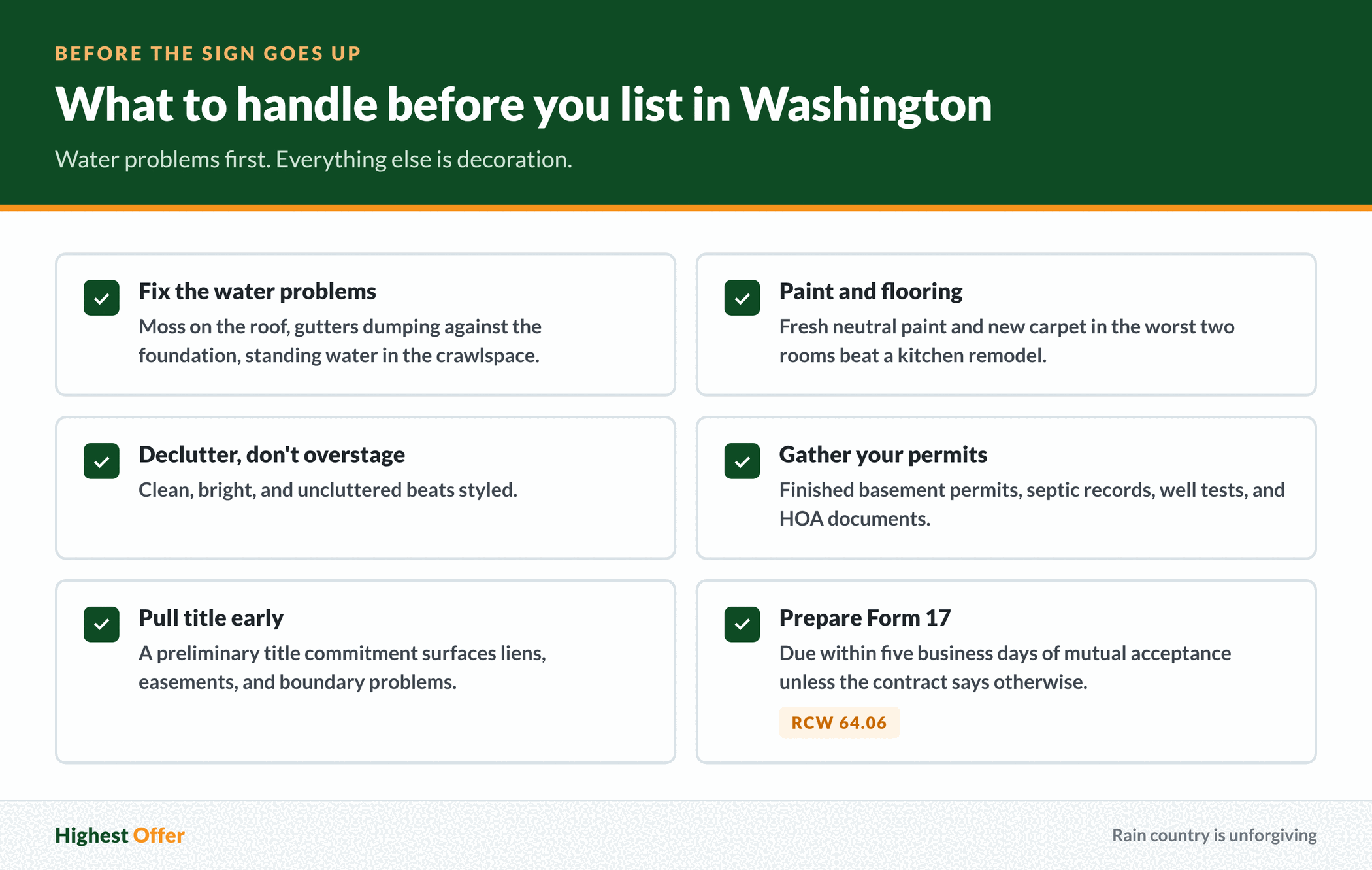
That condition gap is right where the prep conversation starts. Rain country is unforgiving when you try to sell a house. I’m talking about moss on the roof, a gutter that’s dumped water against the foundation for six winters and a crawlspace with standing water. Those show up in every Washington inspection report I’ve ever read.
Fix the water problems first. Everything else is decoration.
In my experience, paint and flooring return more than kitchens do. A full remodel before you sell a house rarely pays back what you put in, and you’ll wait six weeks for a contractor to even show up. Neutral interior paint, new carpet in the worst two rooms and a serious declutter will do more for your sale price than quartz countertops. That’s held true in every sale I’ve watched close.
Here’s where I’ll disagree with a lot of agents: staging every room is oversold. Empty houses do photograph poorly. You still don’t need a stager’s full inventory in a Spokane Valley ranch, and clean, bright and uncluttered beats styled.
A longtime landlord in Lakewood came to me after two agent listings on his duplex expired with zero offers. Early last year his second listing agent had him repaint and power-wash the siding, while the garage still held three decades of tenant leavings stacked to the ceiling. Buyers walked in, saw the work ahead of them and walked right back out.
Most people underplan the paperwork. Think permits for that finished basement, septic records if you’re rural, well test results and HOA documents where they apply. Washington closings crawl when a seller can’t produce a permit for work done fifteen years ago.
Then there’s Form 17. Washington law requires sellers to deliver a completed seller disclosure statement, known as Form 17, within five business days of mutual acceptance unless the contract says otherwise. From delivery, the buyer has three business days to rescind the agreement. The requirement comes from RCW 64.06, the Washington Seller Disclosure Act, and you can read the chapter yourself on the Washington State Legislature site. Fill it out honestly, and fill it out early.
Is Selling a House Without a Realtor Worth It in Washington?
On paper it sounds great to skip the listing agent, keep the commission and pocket an extra five percent. It falls apart because a for sale by owner still typically pays the buyer’s agent, so the savings shrink to a couple of percent against a much harder job.
I’ve watched FSBO sellers in Washington sell a house beautifully, and I’ve watched others stall out for six months. Exposure and pricing discipline almost always explain the difference.
Can you list on the MLS without a full-service broker? Yes. Flat-fee multiple listing service companies operate all over Washington, and a few hundred dollars gets your property syndicated to Zillow, Redfin and every other portal buyers use. Without MLS exposure, you’re counting on a yard sign and luck.
What you really get from a real estate broker is negotiation and transaction management. An experienced agent handles inspection responses, appraisal gaps, lender delays and title issues every week. A first-time seller handles them once.
Selling by owner makes the most sense in three situations, and I’ve seen each one play out firsthand. Maybe you already have a buyer lined up. Maybe your property sits in a hot pocket where anything listed moves. Or you’re selling something so unusual that conventional marketing wouldn’t help anyway.
Owners of distressed or inherited property often forget another path, which is selling directly to a local investor. There’s no listing, no showings and no commission. From my years buying houses this way, it’s worth a call to Highest Offer, one Washington buyer who can give you a baseline cash number before you commit to a listing strategy.
Is it worth it to sell a house without an agent? If you’re organized, patient and realistic about price, the savings are real. If you’re shaky on any of that, hire someone.
What Are the Steps to Sell a House Without a Realtor in Washington?
“Where do I even start?”
Order a title report first. Not last. A preliminary title commitment from any Washington escrow company costs a few hundred dollars and turns up liens, easements and boundary problems while there’s still time to clear them. Old contractor liens and unreleased mortgage balances show up constantly.
Price it next with the comps you pulled, then get professional photos. Phone pictures of a Washington interior in November, with that gray light coming through the windows, will cost you more in buyer interest than the photographer charges.
List it on the MLS through a flat-fee broker. Set showing hours you can actually keep. Vacant homes do fine with a lockbox, while occupied ones need appointments.
Offers come in on the standard NWMLS sale contract, Form 21, across most of Washington, even in FSBO sales, because buyer agents use the forms they know. Read every line before you agree to sell a house on those terms. Your next sixty days will be shaped by three of them: the financing contingency, the inspection timeline and the closing date.
In practice, escrow is mandatory here. Washington runs most residential transactions through escrow companies and title insurers instead of closing attorneys, though a real estate attorney is cheap insurance when you sell a house without representation.
Unrepresented sellers often answer inspection requests emotionally instead of commercially. A buyer asks for $9,000 in repairs, the seller gets insulted and counters at zero, and the sale dies. That buyer’s next offer would’ve come in lower anyway, so the seller traded a known number for an unknown one.
Deliver your disclosure on schedule, cooperate with the appraiser and sign your closing documents when escrow calls. That’s the back half of the job.
How Long Does It Take to Sell a House in Washington?
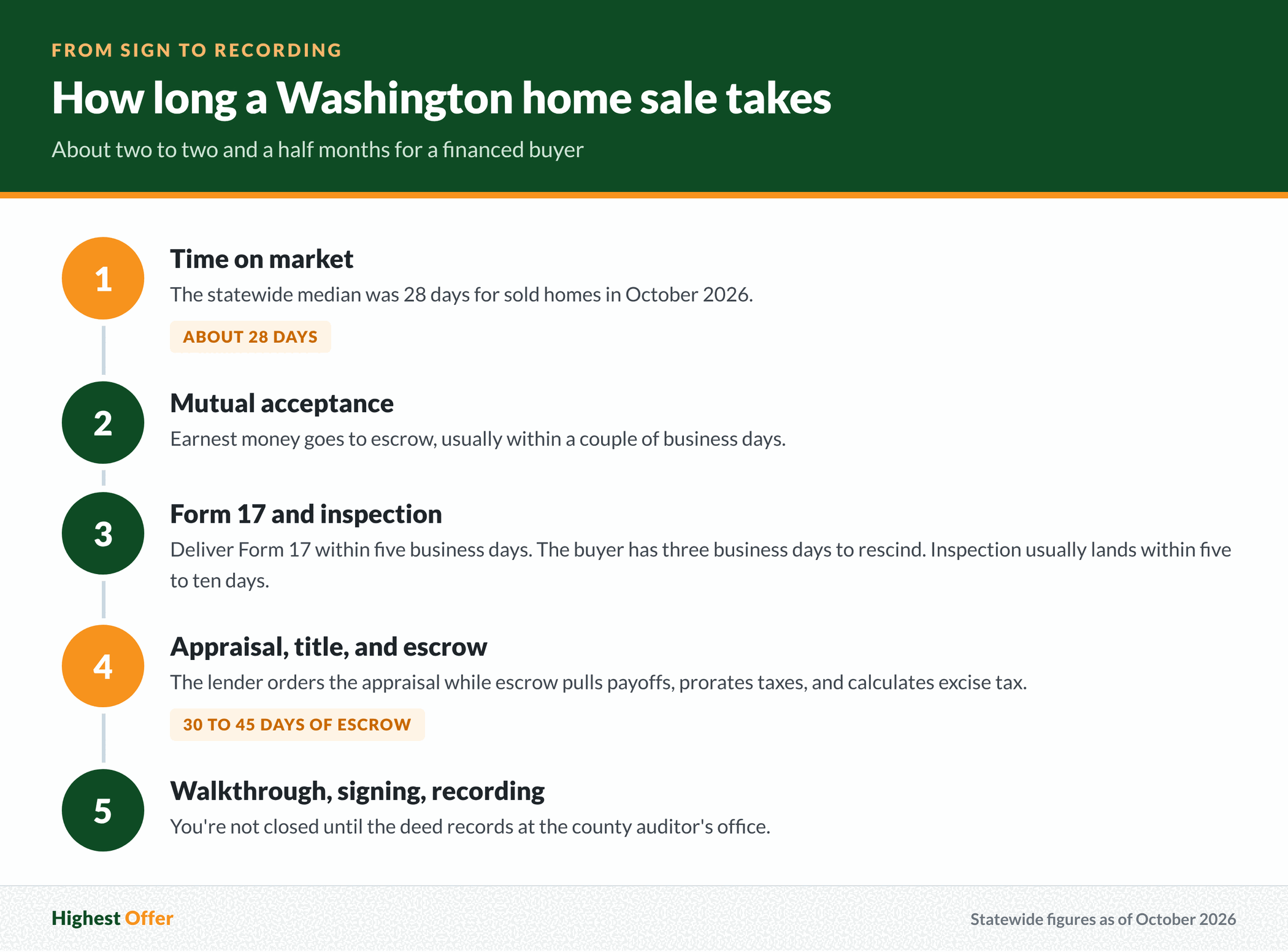
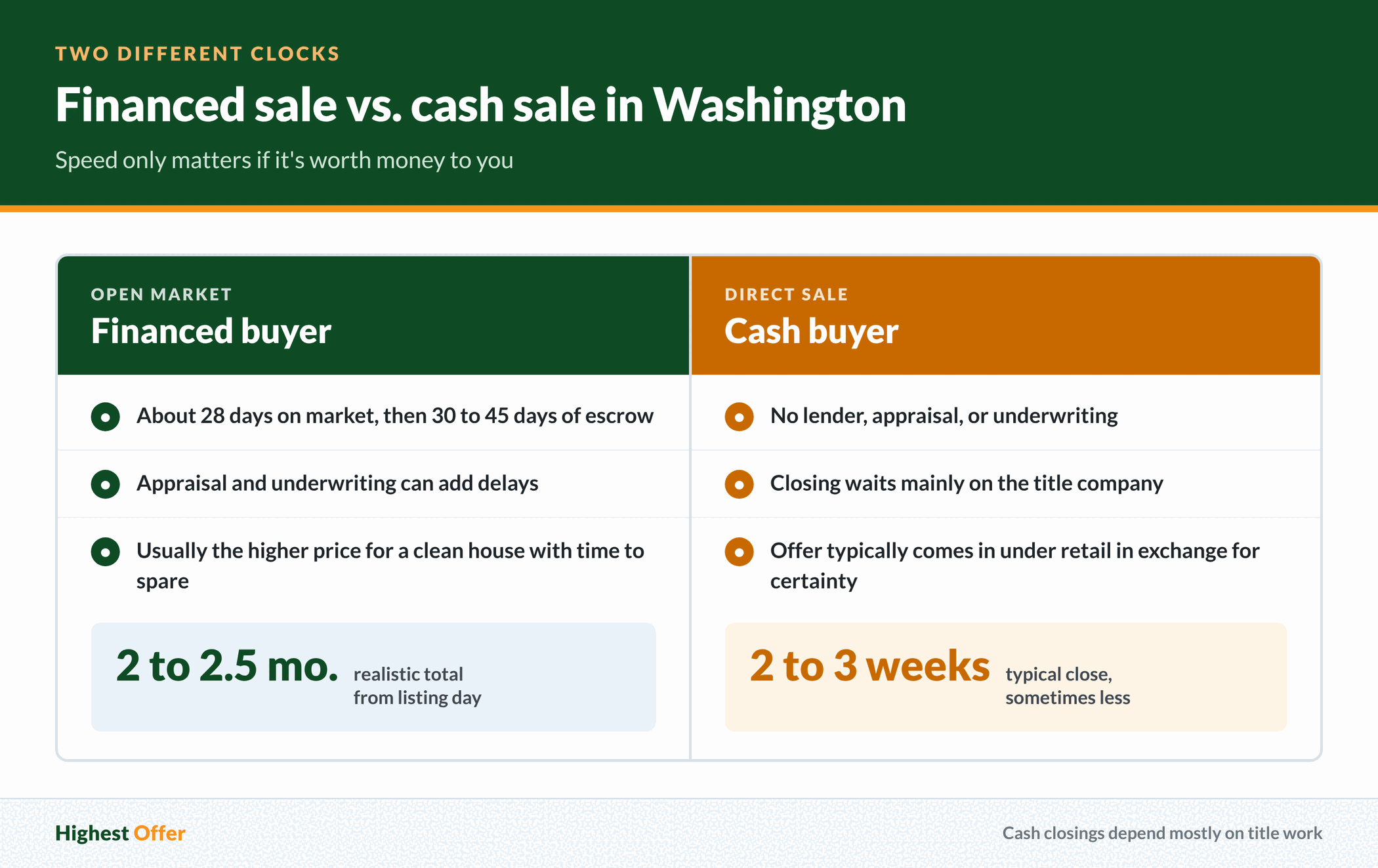
Twenty-eight days. That’s the statewide median days on market for sold homes as of October 2026, on a rolling 90-day basis. A financed buyer adds roughly 30 to 45 days of escrow after mutual acceptance. Put together, your realistic total to sell a house in Washington is about two to two and a half months from the day the sign goes up.
Your local market can move faster or slower than that statewide figure. Seattle homes sold in a median of 22 days active in October 2026, at a median price of $835,000, while Whatcom County ran 34 median days active. Rural listings east of the Cascades move slower still.
Seasonality is real when you sell a house in Washington. Buyer traffic peaks statewide from April through July. Listings that hit in late November often sit through the holidays, and I’d rather see a seller in Everett wait until February than fight December.
Why does a property sit? Usually it’s price first, condition second and location third, and location is the only one you can’t change.
Cash sales run on a completely different clock when you sell a house. With no lender, appraisal or underwriting involved, closing mostly depends on how fast the title company can clear the file. In Washington that’s often two to three weeks, sometimes less. Investors like Highest Offer close on that kind of timeline because no loan committee is involved.
A faster close is only worth chasing if speed is worth money to you. A cash offer typically comes in under retail, and the discount buys certainty. For an owner carrying two mortgage payments or facing a job transfer to Spokane, that certainty is worth plenty. Someone with time and a clean house in Ballard will usually do better on the open market.
What Happens After I Accept an Offer in Washington?
Signing is when the real waiting starts. A retired couple in Olympia accepted an offer on a Tuesday and started packing Wednesday morning. Nineteen days later their buyer’s financing collapsed over a credit inquiry, and they’d already put earnest money down on a condo in Tumwater.
Mutual acceptance starts the clock, not the sale. Earnest money usually goes to escrow within a couple of business days, and then the contingency periods run one after another.
Most Washington contracts put inspection first, usually within five to ten days of mutual acceptance. The buyer hires an inspector, walks the property and comes back to accept it as-is, request repairs, request a credit or terminate. Sewer scopes are standard in older Seattle and Tacoma neighborhoods, and I’ve seen sales stall right there, since a cracked side sewer line is a five-figure conversation.
Your Form 17 goes out during this window. Deliver it late and you’ve handed the buyer a longer escape hatch.
The appraisal follows once the lender orders it. With the statewide sale-to-list ratio at 98.4% in October 2026, low appraisals are rarer than they were in the multiple-offer years, though they still happen on unique properties.
Title and escrow work run in parallel. The escrow officer pulls payoff statements, prorates property taxes, calculates the Washington real estate excise tax owed on the sale and prepares the settlement statement. Excise tax rates are tiered by sale price and vary with local additions, so your escrow officer or the Washington Department of Revenue can give you the exact figure for your transaction.
The final walkthrough happens in the last few days. After that comes signing, recording at the county auditor’s office and funding. In Washington, you aren’t closed until it records.
What Can Delay Closing on a House in Washington?
Picture a clean file with a thirty-day close and everyone happy. Then the appraiser flags peeling exterior paint on an FHA loan, and the seller spends eleven days finding a painter willing to work in February rain.
Lender delays top my list. Underwriting conditions pile up late, especially with self-employed buyers, and a thirty-day close quietly becomes forty-five. Ask for proof of underwriting approval, not just a pre-qualification letter.
Title defects are the sneakier problem. Think of an unreleased lien from a 2009 refinance, a deceased co-owner nobody removed from title or a boundary line that doesn’t match the fence. Each one takes weeks to cure, which is why I push sellers to pull title early.
Inspection renegotiation stalls plenty of Washington sales too. Buyers who find a failing roof mid-escrow usually want it replaced before closing, and roofing crews around Puget Sound are booked out.
Permit problems tend to surface during appraisal or inspection. Unpermitted additions are everywhere in older Washington housing stock, especially converted garages and basement units, and some lenders won’t finance them.
Weather delays are underrated when you sell a house around here. Snoqualmie Pass closures, atmospheric rivers and frozen ground all push inspections and repairs back a few days at a time.
A landlord in Kennewick called me about a rental she’d owned for twenty-two years. The kitchen still had its original harvest-gold cooktop, and her contractor’s estimate came back higher than the kitchen would add in value. She sold it as-is on a Friday instead of sinking another dollar into it.
She read it right. Not every property should go to market polished, and forcing one through a renovation it can’t support is how owners lose months.
Frequently Asked Questions
How Much Commission Would I Pay on a $300,000 House?
Washington commissions are negotiable and usually land in the five to six percent range when both sides have agents. On a $300,000 property, that comes to somewhere between $15,000 and $18,000 total. The 2024 industry settlement changed how buyer-agent compensation is advertised, so you can negotiate what you offer the buyer’s side on its own. Flat-fee brokers charge far less, and a direct sale to an investor carries no commission at all.
How Long Does It Take to Get a Real Estate License in Washington?
Most people finish in a few months. The Department of Licensing requires ninety clock hours of approved pre-license coursework before you can sit for the state and national exam through PSI. Those hours are split between a Real Estate Fundamentals course and a Real Estate Practices course. Once you pass, you’ll clear a background check and affiliate with a managing broker, and the Washington Department of Licensing spells out each step.
Who Usually Pays Closing Costs in Washington State?
Both sides pay, just for different pieces. Sellers in Washington generally cover the real estate excise tax, the owner’s title insurance policy, agent commissions and their share of prorated property taxes. Buyers handle lender fees, their loan’s title policy and prepaid insurance. Escrow fees are commonly split, and everything is negotiable in the contract.
Is Now a Good Time to Sell a House in Washington?
That depends on what you’re optimizing for. Inventory has climbed across Washington, and prices have softened modestly from last year. Sellers don’t get the automatic multiple-offer rush of a few years back anymore. Even so, well-priced homes in Pierce, Snohomish and King still go pending within about a month. With flexibility, the spring buying season gives you the deepest pool of buyers. If you need out now, a direct cash sale sidesteps the seasonal question entirely.
Can I Sell a House in Washington That Needs Major Repairs?
Absolutely, you can sell a house that needs work. Plenty of Washington buyers go looking for properties like that, especially investors and owner-occupants with renovation loans. You’ll disclose known defects on Form 17 either way, and selling as-is just means you aren’t agreeing to fix things before closing. Price it to reflect the condition and you’ll find a buyer.
If you’re weighing a listing, the for-sale-by-owner route or a direct offer, I’m happy to talk it through with you. Tell me about the property, your timeline and what you’re hoping to walk away with. You’ll get a straight read on your options, including the ones that don’t involve me. There’s no pressure, no obligation and no hard sell if listing turns out to be the better move for your situation.
Selling a House in Tacoma and Pierce County
Tacoma moves a little faster than the statewide pace. RexMont reported a median listing price of about $619,000 in September 2026, and Tacoma homes averaged 25 days on market.
Price from recent closed sales near you, plan for escrow and keep your paperwork ready. Owners anywhere in the state can also see how we buy houses in Washington if a direct sale fits better.
Get a Straight Read on Your Washington Timeline
Tell us about your house and the date you need to be out, and we’ll lay out what a listing and a direct sale would each look like for you. You can contact Highest Offer or use the form below.